



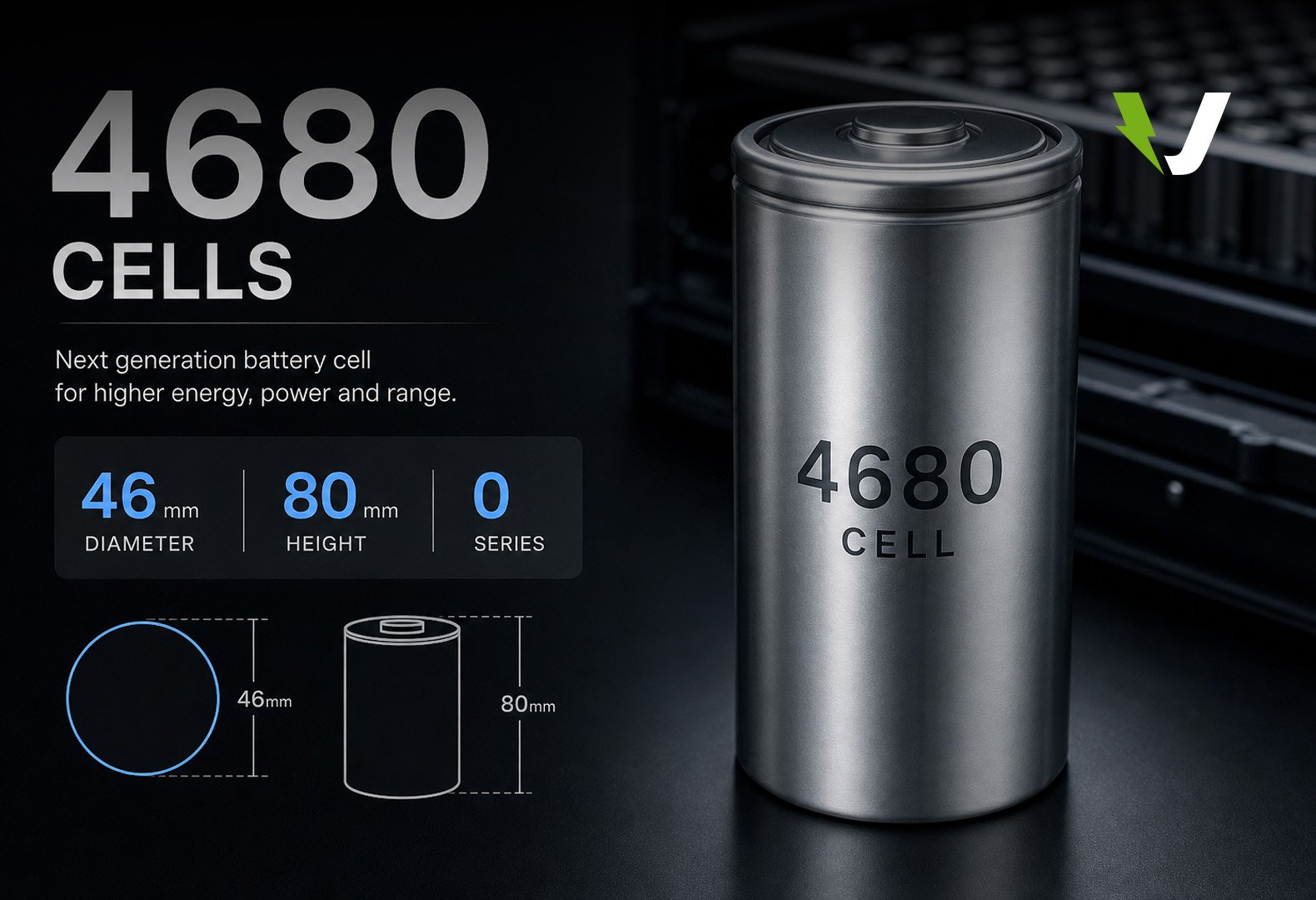
4680 cells are large cylindrical lithium-ion battery cells designed for electric vehicles and energy-intensive applications. The name comes from their approximate physical size: 46 mm in diameter and 80 mm in height.
Tesla brought the format into the spotlight when it introduced its own 4680 program, but the format is no longer limited to Tesla. Panasonic Energy has also developed and begun scaling 4680 production in Japan.
Table of Contents
- What Are 4680 Cells?
- How 4680 Battery Cells Work
- Dry-Electrode and Tabless Technology
- Structural Battery Packs
- 4680 Production Status in 2026
- Advantages and Limitations
- FAQs
- Conclusion
Quick Information
| Feature | 4680 Cell |
|---|---|
| Cell type | Cylindrical lithium-ion |
| Approximate diameter | 46 mm |
| Approximate height | 80 mm |
| Major developers | Tesla, Panasonic Energy |
| Tesla chemistry | Includes nickel-based NCM variants |
| Key Tesla innovation | Tabless current collection |
| Manufacturing focus | Dry-electrode processing |
| Vehicle applications | Cybertruck, selected Model Y packs |
| Tesla Texas installed capacity | 40 GWh |
| Structural pack compatible | Yes |
| Main goal | More energy per cell and simpler packs |
What Are 4680 Cells?
The 4680 cell is much larger than traditional cylindrical EV cells such as the 18650 and 2170 formats. Panasonic explains that cylindrical-cell naming uses the first digits for diameter and the following digits for height, making the 4680 approximately 46 × 80 mm.
Its larger size allows each cell to store considerably more energy than smaller cylindrical cells. Panasonic Energy has said its 4680 format offers about five times the capacity of its earlier 2170 cells, although capacity per cell should not be confused with five times the energy density.
That distinction matters. A physically larger cell naturally contains more active material, so higher capacity does not automatically mean the chemistry itself is five times better.
Internal linking opportunity: Link this section to articles about 2170 vs 4680 batteries, lithium-ion battery chemistry, or EV battery pack design.
How 4680 Battery Cells Work
Like other lithium-ion cells, 4680 batteries move lithium ions between the positive and negative electrodes during charging and discharging.
A typical cell contains:
- Cathode material
- Anode material
- Electrolyte
- Separator
- Current collectors
- Cylindrical metal casing
Tesla’s published Cybertruck battery-passport information identifies its 4680 chemistry as nickel-cobalt-manganese (NCM). The same document lists 1,344 cells in the referenced Cybertruck pack, with approximately 123 kWh total energy and an 800V pack architecture.
However, “4680” describes the physical cell format, not one fixed chemistry. Different manufacturers can use different cathode, anode, electrolyte, and manufacturing designs inside a cell of the same dimensions.
Dry-Electrode and Tabless Technology
Tesla’s 4680 program is notable not simply because the cell is larger, but because of how Tesla aims to manufacture it.
The company developed a tabless design, sometimes described more accurately as a continuous current-collection approach. Instead of relying on a small number of conventional tabs to move current into and out of the wound electrode layers, electrical contact is distributed across a much larger area.
This can reduce electrical resistance and improve current flow.
What is dry-electrode manufacturing?
Traditional battery manufacturing usually coats electrode material onto metal foil using liquid solvents. That coating must then pass through large drying ovens.
Dry-electrode processing attempts to apply the active material without the same solvent-heavy coating and drying process. In theory, this can provide several advantages:
- Smaller factory footprint
- Lower energy consumption
- Fewer solvent-processing steps
- Potentially lower production cost
- Faster manufacturing
The challenge is producing dry-coated electrodes consistently at automotive scale.
By early 2026, Tesla reported that it was producing both dry-electrode anodes and cathodes for 4680 cells in Austin, an important milestone because the cathode had historically been the harder part of the dry-process ramp.
Structural Battery Packs
Another major 4680 concept is the structural battery pack.
In a conventional EV, the battery pack sits inside a vehicle structure. In Tesla’s structural approach, the battery pack itself becomes part of the load-bearing vehicle architecture.
Tesla began delivering Model Y vehicles from Gigafactory Texas with 4680 cells and structural battery packs in 2022.
Tesla’s current service documentation still identifies dedicated Model Y structural battery packs, confirming that this pack architecture remains part of its vehicle-service ecosystem.
Why use a structural pack?
Potential advantages include:
- Reduced number of structural parts
- Lower vehicle mass
- Simplified assembly
- Increased chassis stiffness
- More efficient packaging
There is a trade-off, however. Highly integrated battery structures can make certain repairs or pack replacements more complicated than with modular designs.
4680 Production Status in 2026
Tesla’s 4680 program has moved far beyond prototype production, although its path to mass manufacturing has been difficult.
In its 2026 reporting, Tesla listed 40 GWh of installed 4680 annual battery-manufacturing capacity in Texas. The company also confirmed that it had started building battery packs for certain Model Y vehicles using its own 4680 cells.
Tesla stated:
“We now produce dry-electrode for 4680 cells with both anode and cathode made in Austin.”
That is particularly important because dry-cathode manufacturing had previously been one of the most difficult parts of the process.
Panasonic’s 4680 program
Tesla is not the only company working on the format.
Panasonic Energy converted its Wakayama factory in Japan into a major 4680 manufacturing and development site. Panasonic announced in September 2024 that the facility was ready for mass production and described Wakayama as a “mother factory” for future battery-manufacturing techniques.
Panasonic’s later strategy documents continued to reference planned 4680 mass production at Wakayama.
Advantages and Limitations of 4680 Cells
The biggest potential advantage of 4680 cells is reducing the number of individual cells required for a large EV battery.
Fewer, higher-capacity cells can simplify pack assembly and reduce the number of electrical connections. When combined with efficient manufacturing and structural-pack designs, that can reduce cost and complexity.
Advantages
- Higher capacity per individual cell
- Fewer cells needed for a given pack capacity
- Potentially simpler pack construction
- High power capability
- Compatible with structural battery architecture
- Dry-electrode manufacturing could reduce factory costs
- Large-scale domestic manufacturing can strengthen supply chains
Limitations
- Larger cells require careful thermal management
- Manufacturing yields can be difficult to optimize
- Dry-electrode production is technically challenging
- Structural packs can complicate repair
- Larger cell size alone does not guarantee higher energy density
- Production cost benefits depend heavily on manufacturing scale
A useful practical example is Tesla’s Cybertruck. Tesla’s published battery-passport material identifies a 123 kWh pack using only 1,344 4680 cells.
A battery built from smaller cylindrical cells would normally require many more individual units, demonstrating why the larger format can simplify pack architecture.
FAQs
1. What does 4680 mean in batteries?
The number refers to the cell’s approximate dimensions: 46 mm in diameter and 80 mm tall.
2. Are 4680 cells only made by Tesla?
No. Tesla manufactures its own 4680 cells, while Panasonic Energy has also developed 4680 cells and prepared its Wakayama factory for mass production.
3. Which Tesla vehicles use 4680 cells?
Tesla has used 4680 cells in Cybertruck and has confirmed that certain Model Y battery packs are also being produced with 4680 cells.
4. Are 4680 cells better than 2170 cells?
They offer much greater capacity per cell and can reduce the number of cells needed in a pack. Whether they are “better” overall depends on manufacturing cost, chemistry, thermal management, energy density, and vehicle design.
5. What is special about Tesla’s dry-electrode 4680?
Dry-electrode manufacturing aims to avoid some solvent-based coating and drying processes used in conventional electrode production. Tesla confirmed in 2026 that it was producing both dry anodes and cathodes for its Austin-made 4680 cells.
Conclusion
4680 cells represent more than simply a larger cylindrical battery. Their potential comes from combining high-capacity cells with tabless current collection, dry-electrode manufacturing, simpler pack construction, and structural vehicle integration.
For current information, readers can follow Tesla Investor Relations for the company’s latest 4680 production updates, review manufacturing developments through Panasonic Energy, and explore battery and EV research from the U.S. Department of Energy.
The key question for 4680 cells is no longer whether the format can work in production vehicles. It is whether manufacturers can scale these technologies reliably enough to deliver the cost, energy, and manufacturing benefits originally promised.
Read more:
