



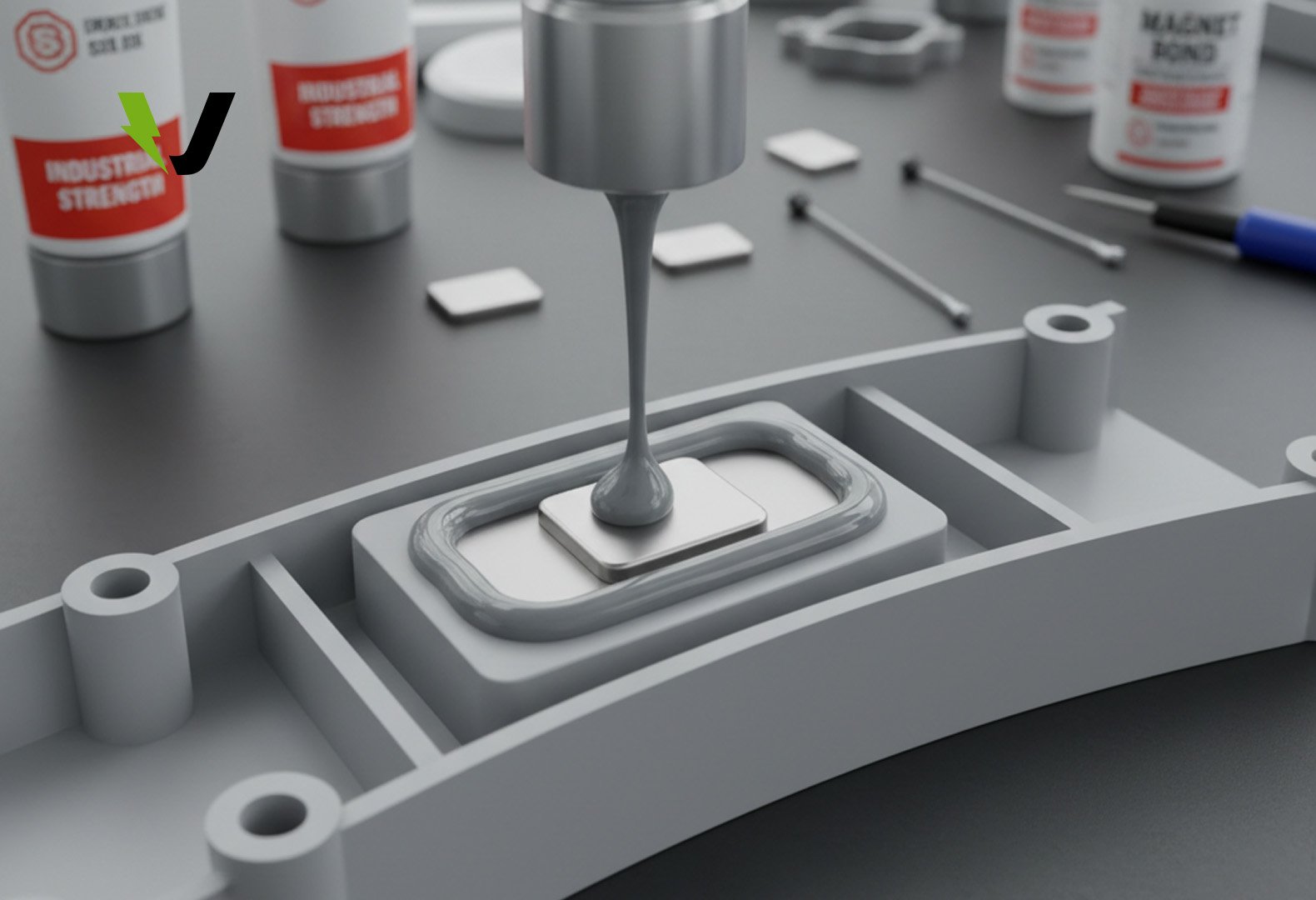
A magnet bonding adhesive is a specialized glue used to attach permanent magnets to metal, plastic, ceramic, or composite parts. It is widely used in electric motors, loudspeakers, sensors, generators, household appliances, and automotive systems.
The right product must do more than hold a magnet in place. It may need to resist heat, vibration, impact, moisture, chemicals, and the forces created by a rapidly rotating motor.
Table of Contents
- What Is Magnet Bonding Adhesive?
- Main Types of Adhesives for Magnets
- How to Choose the Right Adhesive
- Surface Preparation and Application
- Applications, Benefits, and Limitations
- Frequently Asked Questions
- Conclusion
What Is Magnet Bonding Adhesive?
Magnet bonding adhesive creates a structural joint between a magnet and another component. Unlike ordinary household glue, a structural adhesive is designed to carry mechanical loads and maintain its strength in demanding conditions.
It is commonly used to bond ferrite, neodymium-iron-boron, samarium-cobalt, and Alnico magnets. The other surface may be steel, aluminum, coated metal, plastic, or a motor housing.
Quick Information Table
| Feature | Explanation |
|---|---|
| Main purpose | Securing magnets inside an assembly |
| Common adhesive types | Epoxy, structural acrylic, and cyanoacrylate |
| Typical substrates | Ferrite, neodymium, steel, aluminum, and plastics |
| Cure methods | Room temperature, activator, heat, UV, or moisture |
| Important conditions | Heat, vibration, impact, chemicals, and moisture |
| Common uses | Motors, generators, speakers, sensors, and appliances |
| Main risk | Adhesive or magnet coating failure under stress |
| Cost factors | Chemistry, package size, cure method, and production equipment |
Adhesive bonding spreads stress across a larger surface than a screw or clip. It can also avoid drilling into a brittle magnet, which could cause cracks or reduce performance.
Main Types of Adhesives for Magnets
No single adhesive works best for every magnet. Selection depends on the magnet material, surface coating, joint design, operating temperature, production speed, and expected mechanical load.
Epoxy Adhesives
Epoxy is a common choice for strong and durable magnet assemblies. Two-part epoxies can cure at room temperature, while one-part industrial epoxies usually require controlled heating.
Advantages include:
- High shear strength
- Good gap-filling ability
- Resistance to moisture and many chemicals
- Strong performance under vibration
- Availability in different viscosities
Epoxy usually cures more slowly than instant glue. Heat-cured products also require an oven, fixtures, and a cure temperature that will not damage or weaken the magnet.
Structural Acrylic Adhesives
Structural acrylics cure quickly and bond well to many metals and ferrite magnets. Some use two mixed components, while others require an activator on one surface and adhesive on the other.
For example, Henkel describes LOCTITE AA 326 as an activator-cured acrylic for metal and ferrite magnet bonding. The manufacturer lists a fixture time below three minutes and temperature resistance up to 120°C, but those figures apply only to that specific product under defined test conditions.
Cyanoacrylate Adhesives
Cyanoacrylate, often called instant adhesive, develops handling strength very quickly. It can be useful for small magnets in speakers, sensors, and miniature motors.
According to Permabond, cyanoacrylates offer high shear strength but generally have lower impact resistance than structural epoxies and acrylics. Product grades also differ in temperature resistance, viscosity, and gap-filling ability.
| Adhesive | Main advantage | Common limitation |
|---|---|---|
| Epoxy | Durable and gap-filling | Longer cure or heating may be required |
| Structural acrylic | Fast cure and high strength | Activator or accurate mixing may be necessary |
| Cyanoacrylate | Very fast and easy to apply | More brittle under impact |
| Silicone | Flexible and heat-resistant | Usually lower structural strength |
| Double-sided tape | Clean and immediate assembly | Limited suitability for high-speed motors |
How to Choose the Right Adhesive
The first step is identifying the magnet material and coating. Neodymium magnets commonly have nickel, epoxy, zinc, or another protective coating because the underlying material can corrode.
An adhesive may appear to bond well to a coating while the coating itself separates from the magnet. The complete system must therefore be tested, not only the adhesive layer.
Important selection factors include:
- Maximum and minimum operating temperature
- Vibration, shock, and rotational speed
- Required working and fixture time
- Gap size between the parts
- Exposure to oil, water, fuel, or cleaning chemicals
- Magnet coating and mating material
- Production volume and dispensing method
- Need for electrical or thermal conductivity
- Required service life
The cure temperature also matters. Excessive heat can permanently reduce the magnetic strength of some magnet grades. Always compare the adhesive cure schedule with the magnet manufacturer’s permitted temperature.
Internal-link opportunity: Link “types of permanent magnets” to an educational guide comparing neodymium, ferrite, Alnico, and samarium-cobalt magnets.
Surface Preparation and Application
Even a high-strength adhesive can fail on a dirty, oily, oxidized, or loose surface. The parts should be dry and free from grease, dust, release agents, and other contamination.
General preparation usually follows these steps:
- Confirm that the cleaner is safe for the magnet coating.
- Clean both bonding surfaces.
- Lightly abrade the surface only when permitted.
- Remove all abrasion dust.
- Apply a compatible primer or activator if required.
- Dispense the correct amount of adhesive.
- Join and accurately align the parts.
- Hold the assembly still during the specified cure period.
- Allow full curing before applying the final load.
3M recommends a clean–abrade–clean process when abrasion is appropriate. However, aggressive sanding can damage the thin protective coating on a neodymium magnet, so the magnet and adhesive suppliers’ instructions take priority.
Applying too much adhesive can create an unnecessarily thick bond line, interfere with nearby parts, or increase curing time. Too little may leave gaps and reduce the effective bonded area.
Applications, Benefits, and Limitations
Magnet adhesives are used in:
- Electric vehicle traction motors
- Industrial and household motors
- Wind-turbine generators
- Loudspeakers and headphones
- Magnetic sensors and switches
- Power tools
- Pumps and compressors
- Medical and laboratory equipment
Practical Motor Example
In a surface permanent-magnet motor, magnets are attached around a steel rotor. During operation, the joint experiences heat, vibration, and outward force caused by high-speed rotation.
A manufacturer might select a toughened acrylic for rapid room-temperature assembly or a heat-cured epoxy for long-term environmental resistance. The final design should be tested through thermal cycling, overspeed, vibration, and chemical exposure before production.
Advantages
- Distributes stress over the entire joint
- Adds little weight
- Avoids drilling into brittle magnets
- Can fill small manufacturing gaps
- Supports automated dispensing
- May help seal the joint against moisture
Disadvantages
- Requires careful surface preparation
- Cure time can slow production
- Some products require primers or ovens
- Inspection is harder than with visible fasteners
- Heat and chemicals may weaken the bond
- Repair or disassembly can be difficult
Mechanical clips, retaining bands, press fits, or overmolding may be used instead of adhesive. Safety-critical rotating assemblies sometimes combine adhesive with mechanical retention to provide extra protection.
Internal-link opportunity: Add a link to an article explaining adhesive bonding versus mechanical fastening.
Frequently Asked Questions
1. What is the best adhesive for bonding magnets?
Structural epoxy and acrylic adhesives are common choices. The best option depends on the magnet coating, substrate, temperature, vibration, joint gap, and cure process.
2. Can ordinary super glue bond a magnet?
It may work for small, lightly loaded indoor parts. However, it may be too brittle for high-impact, high-temperature, or heavily vibrating equipment.
3. Does epoxy damage neodymium magnets?
Room-temperature epoxy normally does not damage the magnetic material. A heat-cured epoxy could cause problems if its cure temperature exceeds the magnet grade’s limit.
4. Should a magnet be sanded before bonding?
Only if the magnet or coating supplier permits it. Heavy sanding can remove protective plating and expose neodymium material to corrosion.
5. How long does magnet adhesive take to cure?
Fixture time may range from seconds to several hours, while full curing can take longer. Follow the specific technical data sheet rather than assuming that handling strength means full strength.
Conclusion
A reliable magnet bonding adhesive must match the magnet, coating, mating surface, joint design, and service environment. Epoxies offer durable, gap-filling bonds, acrylics provide rapid structural strength, and cyanoacrylates suit some smaller and less demanding assemblies.
Successful bonding depends on controlled preparation, application, alignment, and curing. For motors or other safety-critical products, engineers should test the complete bonded assembly under realistic heat, vibration, speed, moisture, and chemical conditions.
Read More:
