



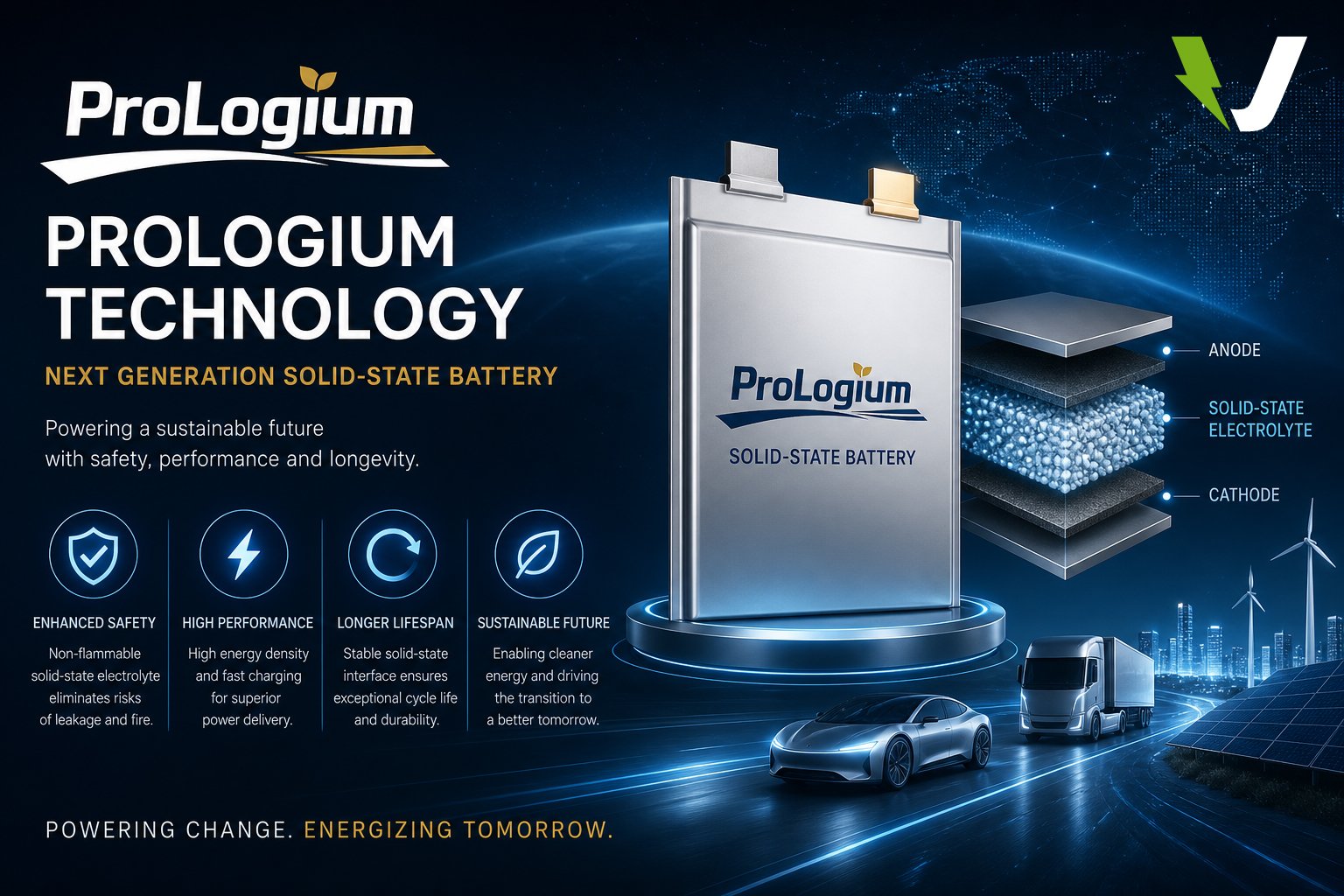
ProLogium Technology is a Taiwan-based battery company focused on solid-state lithium ceramic batteries for electric vehicles and other high-energy applications. Its technology combines solid electrolytes with advanced anodes such as high-silicon materials, aiming to improve energy density, charging speed, safety, and packaging efficiency compared with conventional lithium-ion cells.
In 2026, ProLogium is moving from pilot and GWh-scale production in Taiwan toward larger international commercialization. Construction of its first overseas gigafactory began in Dunkirk, France, in February 2026, while the company continues working with automotive partners and battery-system suppliers.
Table of Contents
- What Is ProLogium Technology?
- How ProLogium’s Solid-State Battery Works
- Energy Density and Fast Charging
- Taiwan Production and Dunkirk Gigafactory
- Automotive Partnerships
- Commercialization Timeline and Risks
- FAQs
- Conclusion
Quick Information
| Detail | Information |
|---|---|
| Company | ProLogium Technology |
| Founded | 2006 |
| Headquarters | Taiwan |
| Main technology | Solid-state lithium ceramic batteries |
| Current advanced anode | 100% silicon composite |
| Claimed Gen 4 energy density | 360–400 Wh/kg |
| Claimed volumetric density | 860–940 Wh/L |
| Taiwan GWh factory | Taoyuan |
| France gigafactory | Dunkirk |
| Dunkirk construction | Began February 2026 |
| Planned Dunkirk ramp-up | Late 2028 to early 2029 |
| Planned mass deliveries | Q2 2029 |
| Key automotive partner | Mercedes-Benz |
What Is ProLogium Technology?
ProLogium develops solid-state battery cells, meaning the conventional flammable liquid electrolyte used in many lithium-ion batteries is replaced largely or entirely by solid or inorganic materials.
The company calls its platform a lithium ceramic battery architecture. Its latest fourth-generation design uses a superfluidized all-inorganic solid-state electrolyte, an all-ceramic separator, and an active safety mechanism. ProLogium says the goal is to improve thermal safety while still allowing high-energy materials such as silicon-rich anodes.
The company says it has shipped more than 2.4 million battery cells since 2013, including over 800,000 third-generation cells produced through its Taiwan GWh facility.
Internal linking opportunity: Link this section to articles about solid-state batteries, silicon anodes, or next-generation EV battery technology.
How ProLogium’s Solid-State Battery Works
A conventional lithium-ion battery typically uses a liquid electrolyte to transport lithium ions between the cathode and anode.
ProLogium replaces that liquid-dominant structure with a ceramic-based solid electrolyte system.
Its current architecture focuses on three main areas:
- Nonflammable electrolyte
- Ceramic separator
- High-silicon anode
- Improved ion transport
- Higher thermal stability
- Reduced risk of thermal runaway
The company says the ceramic structure allows it to use materials that would be more difficult to control in traditional liquid-electrolyte batteries.
100% silicon composite anode
One of the most important parts of ProLogium Technology is its 100% silicon composite anode.
Silicon can theoretically store much more lithium than graphite, but it expands significantly during charging and discharging. That swelling can damage conventional battery cells.
ProLogium says its cell architecture manages this problem well enough to use a much higher proportion of silicon than standard lithium-ion designs.
Energy Density and Fast Charging
ProLogium currently claims 360–400 Wh/kg and approximately 860–940 Wh/L for its fourth-generation silicon-anode cells.
Those figures would be competitive with or higher than many current mass-market lithium-ion cells if reproduced consistently at automotive production scale.
Fast charging claims
Earlier third-generation test cells were reported by ProLogium to achieve:
- 5% to 60% in about 4 minutes
- 5% to 80% in about 6.4 minutes
- More than 1,200 fast-charge cycles in testing
These are company test results rather than broad independent production-vehicle results, so they should be treated as technology claims rather than guaranteed real-world EV charging times.
Actual vehicle charging speed would also depend on pack cooling, charging hardware, vehicle voltage, battery-management software, and charger output.
Taiwan Production and Dunkirk Gigafactory
ProLogium opened its GWh-scale Taoke factory in Taoyuan, Taiwan, in January 2024. The company describes it as the first gigawatt-hour-class solid-state lithium ceramic battery factory.
That plant gives ProLogium a manufacturing base beyond laboratory-scale prototypes.
Dunkirk, France
The company’s next major step is its European plant in Dunkirk.
Construction officially began on February 10, 2026. The plant is intended to manufacture ProLogium’s fourth-generation solid-state lithium ceramic batteries for European customers.
ProLogium’s current timeline says:
- Construction begins: 2026
- Ramp-up: Q4 2028 to Q1 2029
- Commercial production and deliveries: Q2 2029
The French project is supported by a subsidy package of up to approximately €1.4 billion, according to ProLogium’s 2026 investor materials.
Automotive Partnerships
ProLogium has worked with several automotive and battery-system companies.
Mercedes-Benz
Mercedes-Benz and ProLogium announced a technology cooperation agreement in 2022.
Mercedes invested a high double-digit million-euro amount and took a seat on ProLogium’s board, while the companies agreed to work on solid-state EV battery development.
It is important not to confuse this program with Mercedes’ current road-testing of Factorial Energy cells. Mercedes works with more than one solid-state battery partner.
OPmobility
In June 2026, ProLogium and OPmobility signed an MoU to evaluate integrating ProLogium cells into EV modules and packs. The cooperation includes cell testing and potential system-level development for automakers.
Other partnerships
ProLogium has also announced cooperation with:
- ACC
- FEV
- MAHLE
- POSCO
These partnerships cover battery materials, thermal management, pack engineering, and cell-system integration.
Commercialization Timeline and Risks
ProLogium has already produced solid-state cells, but full automotive commercialization remains a different challenge.
The biggest hurdles include:
- High-volume manufacturing yield
- Automotive qualification
- Long-term durability
- Cost per kWh
- Raw-material supply
- Pack integration
- Factory ramp-up
The planned Dunkirk mass-production timeline around 2029 shows that ProLogium is still several years away from large-scale European automotive output.
Nasdaq listing plan
In May 2026, ProLogium announced plans to go public through a merger with Translational Development Acquisition Corp.
The proposed transaction values ProLogium at approximately $3.8 billion pre-money and is intended to fund fourth-generation battery scaling and the Dunkirk project. The combined company is expected to use the ticker PRLG if the transaction closes as planned.
Because this transaction was announced rather than already completed in the source, it should still be treated as pending until final closing is confirmed.
FAQs
1. What does ProLogium Technology make?
ProLogium develops solid-state lithium ceramic battery cells for electric vehicles and other high-energy applications.
2. Is ProLogium already producing solid-state batteries?
Yes. ProLogium operates a GWh-class production facility in Taoyuan, Taiwan, and says it has shipped millions of cells since 2013.
3. What energy density does ProLogium claim?
Its current fourth-generation silicon-anode design targets approximately 360–400 Wh/kg and 860–940 Wh/L.
4. Is Mercedes-Benz using ProLogium batteries?
Mercedes-Benz has a development partnership with ProLogium, but ProLogium cells are not yet confirmed as mass-production batteries in current Mercedes passenger cars.
5. When will the ProLogium France factory begin production?
Current company plans target ramp-up between late 2028 and early 2029, with commercial production and deliveries beginning around Q2 2029.
Conclusion
ProLogium Technology is one of the more advanced companies attempting to commercialize solid-state batteries at industrial scale. Its combination of ceramic solid electrolytes, high-silicon anodes, fast-charging targets, and European manufacturing plans gives it a potentially important role in next-generation EV batteries.
For authoritative technical details, readers can review ProLogium’s core battery technology overview, follow the European manufacturing project through ProLogium’s Dunkirk gigafactory announcement, and examine the automaker partnership through Mercedes-Benz’s ProLogium cooperation announcement.
The key question is no longer whether ProLogium Technology can make solid-state cells. It can. The bigger challenge is whether it can manufacture them at automotive scale, competitive cost, and consistent quality when its European mass-production phase begins later this decade.
Read more:
