


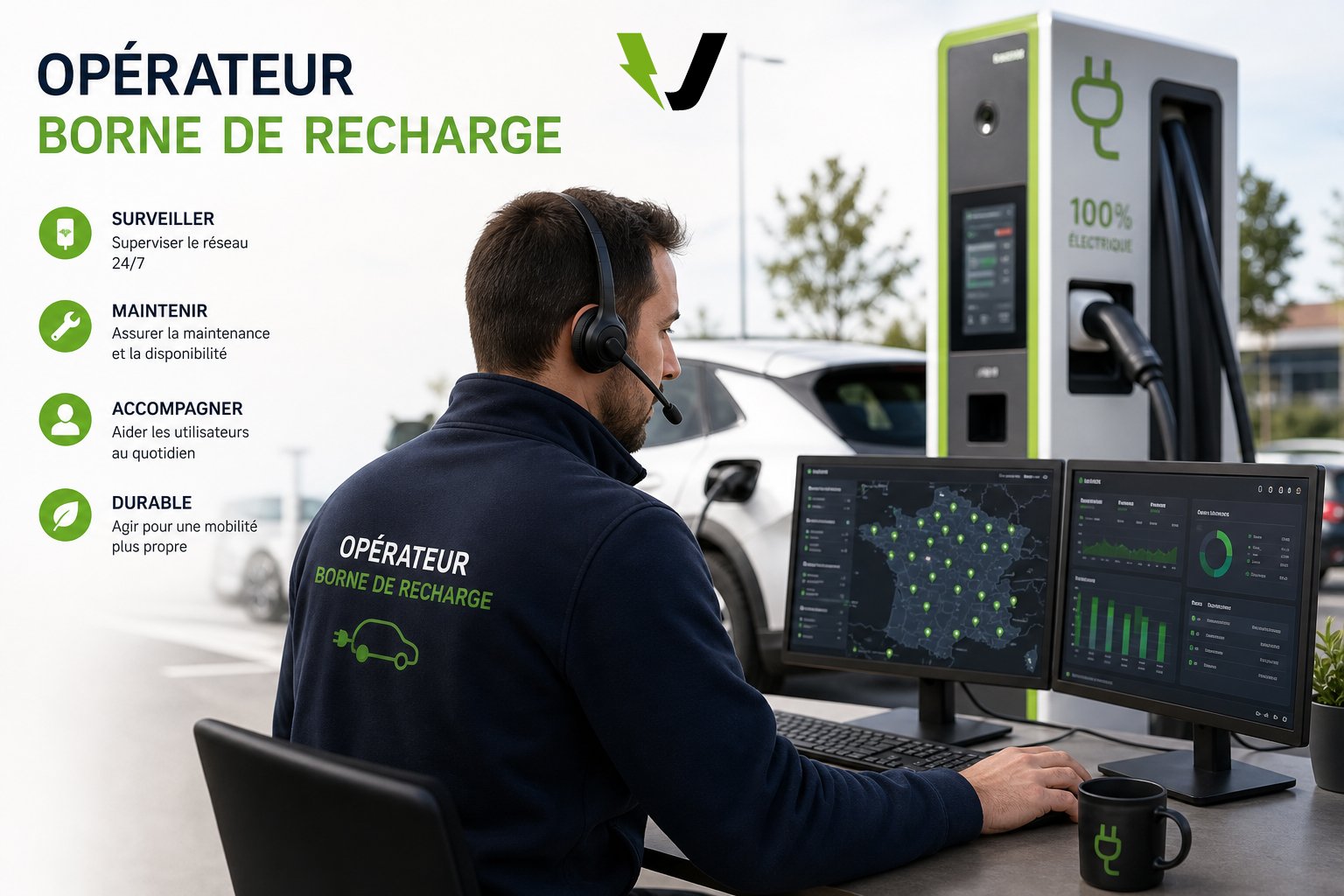
An opérateur borne de recharge is the company responsible for operating electric-vehicle charging infrastructure. In the EV industry, this business is usually called a Charge Point Operator (CPO).
The operator keeps chargers available, connects them to backend software, manages charging sessions, monitors faults, supports payments and may exchange data with mobility providers. In France, the legal definition covers a person operating charging infrastructure for its owner or for itself when it also owns the infrastructure.
Table of Contents
- What Is an Opérateur Borne de Recharge?
- What Does a Charging Operator Do?
- CPO vs eMSP vs Charging-Infrastructure Owner
- Software, OCPP and EV Roaming
- French and EU Rules for Charging Operators
- FAQs
- Conclusion
Quick Information
| Detail | Explanation |
|---|---|
| French term | Opérateur borne de recharge |
| Common English term | Charge Point Operator |
| Abbreviation | CPO |
| Main role | Operate EV charging infrastructure |
| Typical customers | Businesses, cities, retailers, fleets |
| Core software | Charging Station Management System |
| Important protocol | OCPP |
| Roaming connection | CPO ↔ eMSP/platform |
| Key duties | Monitoring, maintenance, payments, data |
| French legal term | Opérateur d’infrastructure de recharge |
| EU regulation | AFIR Regulation (EU) 2023/1804 |
What Is an Opérateur Borne de Recharge?
An opérateur borne de recharge manages the day-to-day operation of one or more EV charging stations. French regulation uses the term opérateur d’infrastructure de recharge for the organization operating charging infrastructure on behalf of an aménageur or on its own behalf when it also performs that role.
A charging operator may manage just a few chargers at an office building or thousands of public DC fast chargers distributed across a country.
Typical charging locations include:
- Public car parks
- Motorway service areas
- Shopping centers
- Hotels
- Fleet depots
- Offices
- Municipal parking
- Apartment developments
The operator does not always own the physical charging stations. Ownership, installation and operation can be divided between several companies.
Internal linking opportunity: Link this section to articles about OCPP software, OCPI, or dynamic EV charging management.
What Does a Charging Operator Do?
The CPO’s biggest responsibility is keeping charging infrastructure usable.
Modern chargers are normally connected to a central Charging Station Management System, or CSMS. The operator can use this software to see whether chargers are online, occupied, available or reporting faults.
Typical CPO responsibilities
An operator may handle:
- Remote charger monitoring
- Charging-session management
- Preventive maintenance
- Fault diagnosis
- Technician dispatch
- Electricity metering
- Tariff configuration
- Payment processing
- RFID authorization
- Remote start and stop
- Firmware updates
- Smart charging
- Usage reports
- Customer support
Reliability is especially important. The Open Charge Alliance explains that OCPP messages can help charging operators identify failures and monitor charger uptime, although OCPP itself does not guarantee reliability.
Practical example
Imagine a supermarket owns ten charging points but does not want to operate them itself.
A CPO could connect the chargers to its software platform, monitor them continuously, set prices, manage customer sessions and arrange repairs. The supermarket remains the site owner while the operator handles daily technical operations.
CPO vs eMSP vs Charging-Infrastructure Owner
Several EV-charging roles are often confused.
French regulation distinguishes between the aménageur, infrastructure operator and mobility operator.
| Role | Main responsibility |
|---|---|
| Infrastructure owner/aménageur | Develops or owns charging infrastructure |
| CPO | Operates the charging stations |
| eMSP | Provides charging access to EV drivers |
| Roaming platform | Exchanges data between CPOs and eMSPs |
An eMSP, or eMobility Service Provider, typically provides the customer-facing charging card or app.
For example, a driver may use an eMSP subscription to charge on infrastructure operated by several different CPOs.
Why this distinction matters
The CPO is mainly responsible for the infrastructure side.
The eMSP focuses more on the driver relationship, which can include:
- Mobile application
- RFID charging card
- Charging history
- Customer billing
- Roaming access
- Subscription plans
One company can perform both roles, but they remain different functions.
Software, OCPP and EV Roaming
Operating hundreds of chargers manually would be inefficient. Most professional operators therefore depend on cloud-based charging software.
One of the most important technologies is OCPP, or Open Charge Point Protocol.
The basic communication chain is:
EV charger → OCPP → CSMS → CPO
The Open Charge Alliance currently maintains OCPP 1.6, 2.0.1 and 2.1 specifications. OCPP allows charging stations and compatible management platforms to exchange standardized commands and operating information.
What can charging software monitor?
A CPO dashboard may show:
- Charger availability
- Connector status
- Power delivered
- Session duration
- Energy consumed
- Fault codes
- Firmware version
- Customer authorization
- Revenue
- Electricity cost
Smart-charging functions can also limit charging power when a site’s electrical demand becomes too high.
Roaming
Another layer connects the CPO with mobility providers.
A driver may therefore use one charging card on several networks even though those networks are operated by different companies.
In France, regulation explicitly recognizes charging roaming and interoperability platforms as part of the charging ecosystem.
French and EU Rules for Charging Operators
Public charging operators operate inside an increasingly detailed regulatory framework.
France’s Energy Code requires charging-infrastructure operators to make information about the actual maximum charging power available to the public.
France also requires public charging infrastructure data to be published. Transport.data.gouv.fr explains that static data includes station location and technical characteristics, while dynamic information includes operating condition and connector availability. Infrastructure owners can delegate publication to their operators.
AFIR payment requirements
The EU’s Alternative Fuels Infrastructure Regulation (AFIR) has also changed public charging.
Drivers using covered publicly accessible chargers must have an ad hoc charging option, meaning they should be able to pay without needing a long-term subscription.
The European Commission explains that payment can use secure electronic solutions, including compliant card or web-based methods depending on the charging station and applicable AFIR requirements. A charging-provider app requiring registration alone does not automatically satisfy the ad hoc requirement.
Charging data requirements
AFIR also requires operators or owners of publicly accessible charging infrastructure to make important static and dynamic data available.
This includes information such as:
- Operator identity
- Location
- Connector type
- Charging power
- Payment options
- Operational status
- Availability
- Ad hoc price
- Plug & Charge capability
- Smart-charging availability
The rules require API-based access to this information.
EU implementing rules introduced in 2025 require static information to be updated no later than 24 hours after a change and dynamic information no later than one minute after a change.
Advantages of using a professional CPO
- Centralized charger monitoring
- Faster fault detection
- Payment management
- Roaming integration
- Smart charging
- Usage analytics
- Regulatory data management
- Remote maintenance
- Scalable network management
Possible disadvantages
- Monthly software or management fees
- Dependence on backend connectivity
- Contract commitments
- Integration complexity
- Possible vendor lock-in
- Payment transaction costs
Businesses should therefore examine interoperability and data ownership before choosing an operator.
FAQs
1. What does opérateur borne de recharge mean?
It means EV charging station operator, commonly called a Charge Point Operator or CPO. The operator manages charging infrastructure and its daily operation.
2. Is a CPO the same as an eMSP?
No. A CPO primarily operates chargers, while an eMSP provides charging-access services to EV drivers. One company can perform both roles.
3. Does the charging operator own the chargers?
Not necessarily. French law allows an infrastructure operator to operate chargers for an infrastructure owner under contract or for itself when it also owns the infrastructure.
4. What software does a charging operator use?
CPOs commonly use a Charging Station Management System with OCPP for charger monitoring, session management, remote control, tariffs, maintenance and smart charging.
5. What should I check before choosing a CPO?
Check charger compatibility, OCPP support, uptime monitoring, maintenance response, roaming, payment options, pricing, data ownership, cybersecurity, reporting and contract exit conditions.
Conclusion
An opérateur borne de recharge plays a central role in modern EV infrastructure. The CPO turns physical chargers into an operational network by combining monitoring, maintenance, payments, connectivity, smart charging and customer support.
Companies planning charging infrastructure can verify French operator definitions through Légifrance, review public-charging requirements through the European Commission, and examine charger interoperability standards through the Open Charge Alliance.
For businesses selecting an opérateur borne de recharge, price should not be the only consideration. Charger uptime, software interoperability, maintenance quality, payment flexibility, regulatory compliance and access to operational data are equally important for building a reliable charging network.
Read more:
