



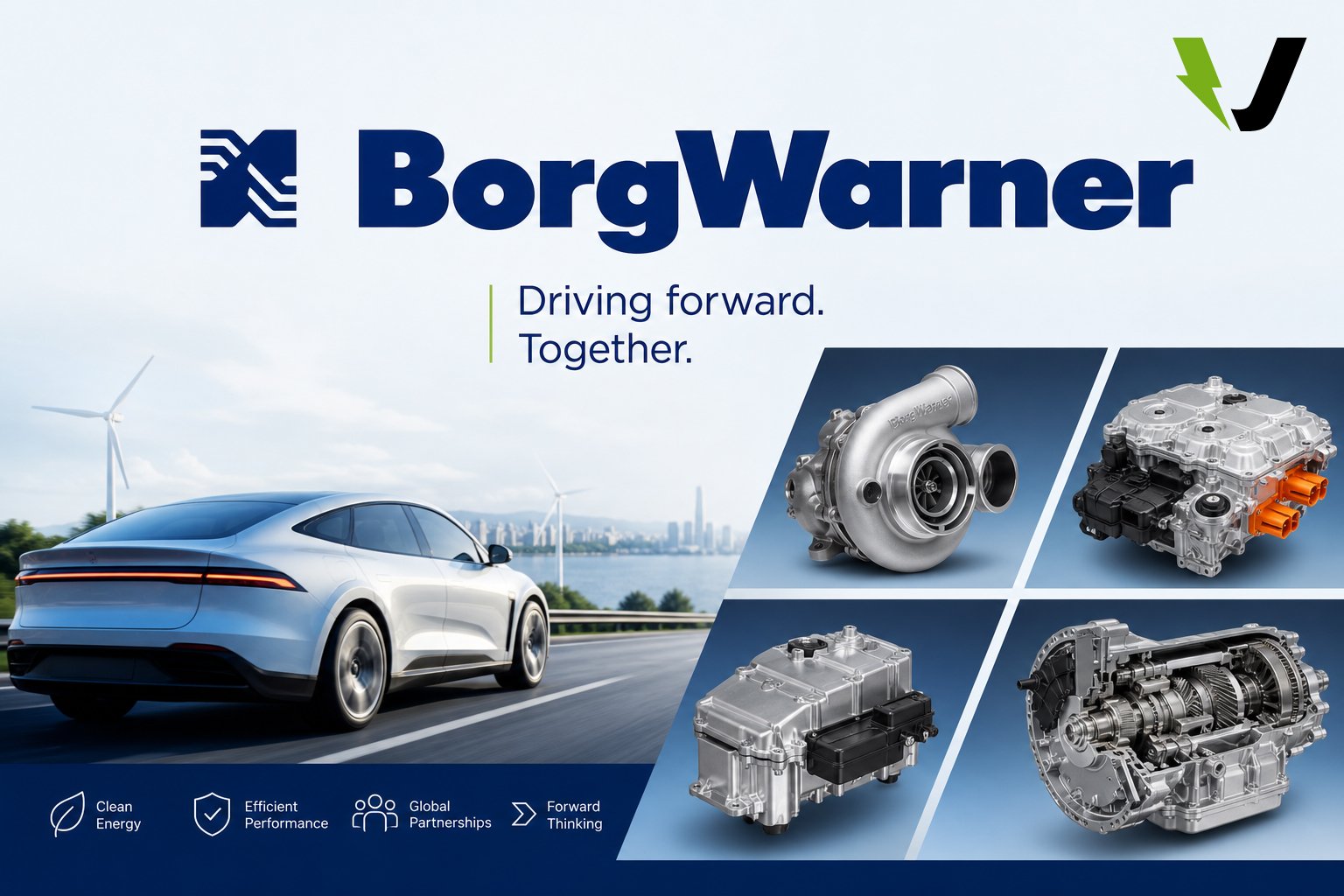
BorgWarner is a major global automotive supplier that develops propulsion, power-electronics, battery, thermal-management, and drivetrain technologies for electric, hybrid, and combustion vehicles. The company has more than 130 years of automotive history and has spent the last several years shifting more of its business toward electrified mobility.
That transition is still evolving in 2026. BorgWarner continues to win new EV inverter, battery-management, and integrated-drive programs, but it has also become more selective about where it invests. Notably, it exited its standalone charging business in 2025 and now focuses its former Battery & Charging Systems segment on battery energy systems.
Table of Contents
- What Is BorgWarner?
- BorgWarner’s Role in Electric Vehicles
- Electric Drive Modules and Inverters
- Battery Systems and Battery Management
- What Happened to BorgWarner’s Charging Business?
- 2026 Financial Performance and Strategy
- FAQs
- Conclusion
Quick Information
| Detail | Information |
|---|---|
| Company | BorgWarner Inc. |
| Headquarters | Auburn Hills, Michigan |
| Stock ticker | BWA |
| Main industry | Automotive technology |
| 2025 net sales | $14.316 billion |
| 2025 eProducts revenue | $2.57 billion |
| 2025 eProducts share | 18% of revenue |
| 2025 eProducts growth | About 23% |
| Main EV products | eMotors, iDMs, inverters, BMS, battery systems |
| Battery voltages supported | Up to 800V in several systems |
| Charging hardware business | Exited in 2025 |
| 2026 Q2 sales | $3.648 billion |
BorgWarner’s reported eProducts category includes products used in EVs as well as technologies used in hybrids that can also be applied to electric drivetrains.
What Is BorgWarner?
BorgWarner is a Tier 1 automotive supplier rather than a vehicle manufacturer. It supplies technologies and components to original equipment manufacturers, commonly called OEMs.
Its portfolio covers both traditional and electrified propulsion, including:
- Electric motors
- Integrated drive modules
- Traction inverters
- Onboard charging electronics
- Battery-management systems
- Battery packs
- Turbochargers
- Thermal-management systems
- Timing and drivetrain technologies
BorgWarner says it works with major automakers across Europe, Asia, and the Americas and is positioning its portfolio around electric, hybrid, and efficient combustion technologies rather than relying entirely on one powertrain type.
Internal linking opportunity: Link this section to articles about automotive Tier 1 suppliers, EV power electronics, or electric drive modules.
BorgWarner’s Role in Electric Vehicles
The company’s electrification strategy is called Charging Forward 2027.
When BorgWarner announced the strategy in 2023, it targeted more than $10 billion of eProduct sales by 2027 and expected those products to represent nearly half of total revenue.
Actual market conditions have since become more complicated, especially because EV adoption has developed at different speeds across regions.
In 2025, BorgWarner generated $2.57 billion of eProducts revenue, equal to 18% of total sales. The company also reported that light-vehicle eProducts sales increased about 23% year over year, supported by hybrid and EV demand in Europe and Asia.
This means electrification remains important, but BorgWarner’s business is still much broader than pure EV technology.
Electric Drive Modules and Inverters
One of BorgWarner’s core EV technologies is the Integrated Drive Module, or iDM.
An iDM can combine several components into one compact unit:
- Electric motor
- Inverter
- Gear reduction
- Power electronics
- Vehicle-control software
- Optional parking lock
Combining these systems can reduce complexity, save packaging space, and improve efficiency compared with purchasing each component separately.
New 2026 iDM program
In August 2026, BorgWarner announced a new next-generation iDM award from a global automaker, with production expected to start in 2027. The company described the system as focused on improved performance, efficiency, and integration.
800V inverters
BorgWarner is also active in high-voltage power electronics.
In August 2026, it secured extensions of several inverter programs with a major European OEM covering both plug-in hybrids and 800V battery-electric vehicles. The 800V inverter uses silicon-carbide power switches and dual-sided cooling, with production planned from 2029.
Silicon carbide, commonly shortened to SiC, can reduce electrical losses and improve efficiency at high voltage compared with traditional silicon-based power electronics.
Battery Systems and Battery Management
BorgWarner also develops complete battery systems for applications such as buses, commercial vehicles, marine equipment, and off-highway machinery.
Its battery portfolio supports both NMC and LFP cell chemistries and includes modular battery-management software for monitoring:
- State of charge
- State of health
- State of energy
- Temperature
- Cell voltage
- Safety conditions
Battery-management systems
In February 2026, BorgWarner announced an expanded Battery Management System program with a global OEM.
The BMS is already in production and will be expanded to additional BEVs, plug-in hybrids, and light commercial vehicles beginning in 2029. It supports battery architectures up to 800 volts and includes monitoring, diagnostics, passive cell balancing, and fast-charging communication.
A BMS is critical because it helps protect the battery pack while estimating usable energy and controlling how individual cells are charged and discharged.
What Happened to BorgWarner’s Charging Business?
Despite the name Charging Forward, BorgWarner no longer operates the same standalone EV charging hardware business it previously built.
In February 2025, the company decided to exit that charging business after reviewing its portfolio and future investment priorities.
Production operations stopped during the second quarter of 2025. BorgWarner said the exit was expected to eliminate roughly $30 million of annual adjusted operating losses by 2026.
The former Battery & Charging Systems segment was subsequently renamed Battery Energy Systems.
Important distinction
BorgWarner still produces onboard battery chargers and related power electronics used inside electric vehicles.
These systems convert AC electricity from the grid into DC electricity for the battery and support outputs such as:
- 7.4 kW
- 11 kW
- 22 kW
They can support 400V, 650V, and 800V battery architectures.
So BorgWarner exited the external charging-station business, not all charging-related technology.
2026 Financial Performance and Strategy
BorgWarner reported $3.648 billion in Q2 2026 sales, roughly flat compared with the previous year.
Its GAAP operating margin improved to 10.1%, while adjusted operating margin reached 11.3%. Free cash flow for the quarter was $492 million.
The company expects full-year 2026 sales between $14.0 billion and $14.3 billion.
However, Battery Energy Systems revenue is expected to decline by roughly $250 million year over year, creating a meaningful drag on total growth.
BorgWarner’s current approach
Its strategy now appears more balanced than simply maximizing EV exposure.
The company is investing in:
- Battery-electric vehicles
- Plug-in hybrids
- Hybrid powertrains
- High-efficiency combustion technologies
- Battery systems
- Power electronics
This reduces dependence on one propulsion technology at a time when EV adoption rates vary significantly by country.
FAQs
1. What does BorgWarner do?
BorgWarner develops automotive technologies including electric drive modules, inverters, battery systems, BMS hardware and software, turbochargers, thermal systems, and drivetrain components.
2. Does BorgWarner make EV batteries?
Yes. BorgWarner develops modular battery systems for commercial, off-highway, marine, and other electrified applications, using chemistries including NMC and LFP.
3. Does BorgWarner still make EV chargers?
It exited its standalone charging-station business in 2025. However, it still develops onboard charging electronics installed inside electric and plug-in hybrid vehicles.
4. What are BorgWarner eProducts?
eProducts include technologies used in electric vehicles plus related hybrid technologies whose underlying designs can also be applied to EV propulsion.
5. Is BorgWarner focused only on EVs?
No. BorgWarner continues to supply electric, hybrid, and combustion technologies. Its strategy reflects different adoption rates across global automotive markets.
Conclusion
BorgWarner is evolving from a company historically associated with conventional drivetrain technologies into a broader electrification and mobility supplier. Its current portfolio includes high-voltage inverters, electric drive modules, battery-management systems, complete battery solutions, and hybrid technologies.
For current corporate information, readers can explore BorgWarner’s official company overview, review the latest financial performance through BorgWarner Investor Relations, and examine its electric technology portfolio through BorgWarner Technologies.
The key story in 2026 is selectivity. BorgWarner is still expanding in EV drive systems and high-voltage electronics, but its exit from standalone charging hardware shows that the company is willing to leave less-profitable areas while concentrating investment on technologies where it believes it can achieve stronger scale and margins.
Read more:
