



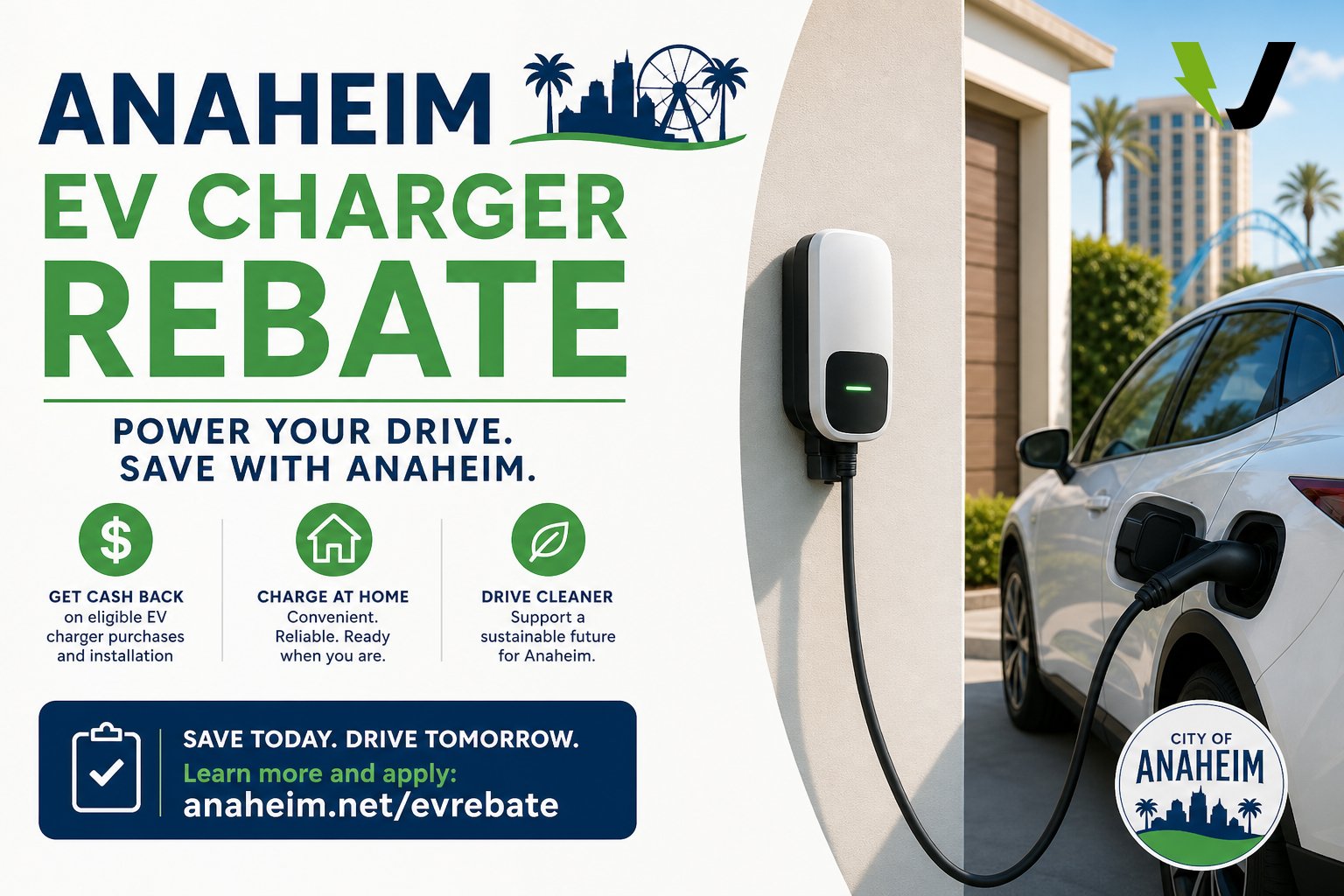
The Anaheim EV charger rebate can help Anaheim Public Utilities customers reduce the cost of installing Level 2 or higher electric-vehicle charging equipment at homes, businesses, public locations, schools, affordable housing properties, and fleet sites.
As of September 2026, Anaheim Public Utilities offers several separate charging incentives. Residential and private-use customers can receive up to $300 for a Level 2 charger, up to $600 for a networked charger when enrolled in an eligible time-of-use rate, plus up to $750 for qualifying electrical-panel upgrades. Larger commercial and fleet projects can qualify for substantially higher amounts.
Table of Contents
- What Is the Anaheim EV Charger Rebate?
- Residential and Private-Use Rebates
- Public and Multifamily Charging Rebates
- Fleet and Commercial EV Charger Incentives
- Eligibility and Application Requirements
- Is the Anaheim EV Charger Rebate Worth It?
- FAQs
- Conclusion
Quick Information
| Program | Current Rebate |
|---|---|
| Private-use Level 2 charger | Up to $300 |
| Networked private charger + TOU rate | Up to $600 |
| Electrical panel upgrade | Additional up to $750 |
| Public-access commercial charger | Up to $3,500 per charger |
| School/affordable housing/public DC fast charger | Up to $7,500 per charger |
| Commercial fleet charger | Up to $5,000 per charger |
| School fleet charger | Up to $10,000 per charger |
| Commercial fleet maximum | Up to $75,000 |
| Public-access commercial maximum | Up to $25,000 |
| Enhanced public-access maximum | Up to $40,000 |
All programs remain subject to available funding, so an advertised amount should not be treated as guaranteed until the application or reservation is approved.
What Is the Anaheim EV Charger Rebate?
The Anaheim EV charger rebate is offered by Anaheim Public Utilities, the municipal utility serving Anaheim, California.
Unlike a vehicle-purchase rebate, this program focuses on the infrastructure required to charge an electric car. Eligible costs can include the charging equipment itself, professional installation, certain electrical upgrades, and qualifying permit expenses depending on the program.
The utility operates different programs because a homeowner installing one charger has very different costs from a business building a 20-charger fleet depot.
Internal linking opportunity: Link this section to articles about California EV incentives, Level 2 home charging, or EV charger installation cost.
Residential and Private-Use Anaheim EV Charger Rebate
For a private charger installed at a home or business, Anaheim Public Utilities currently provides two main charger incentive levels.
Standard Level 2 charger
Customers can receive up to $300 toward an eligible Level 2 charger.
Level 2 charging generally uses a 240-volt electrical circuit and is considerably faster than basic 120-volt charging.
Networked charger with time-of-use rate
A customer installing a qualifying networked charger can receive up to $600 if they enroll in the applicable Anaheim Public Utilities time-of-use rate.
A networked charger connects to the internet and can provide features such as:
- Charging history
- Remote controls
- Charging schedules
- Energy monitoring
- Access management
- Real-time operating information
Anaheim’s EV FAQ confirms that a customer with a networked charger can still receive the $300 level without immediately joining the TOU rate. The customer may later become eligible for the additional amount if they enroll within the permitted period.
Electrical panel upgrade rebate
Private-use participants may also receive an additional rebate of up to $750 for electrical-panel upgrades needed to accommodate the charger.
This can be useful for older homes where installing a Level 2 charger requires a new panel, increased electrical capacity, or related service work.
Public and Multifamily Charging Rebates
The incentives become much larger when chargers are available to the public, apartment residents, commuters, or visitors.
Anaheim Public Utilities currently lists up to $3,500 per Level 2 charger for eligible commercial public-access sites, up to a program maximum of $25,000.
Enhanced incentives are available for certain installations.
Up to $7,500 per charger
Schools, affordable housing properties, and qualifying publicly accessible DC fast chargers may receive up to $7,500 per charger, subject to a maximum of $40,000 under the current commercial program summary.
Eligible expenses generally include:
- Charger purchase
- Installation
- Electrical work related to installation
The public-access program also requires customers to reserve the rebate before moving through the complete installation and reimbursement process.
Multifamily properties
Apartment charging can fall within Anaheim’s public-access structure when chargers are available to residents.
Property owners should verify the exact program before purchasing equipment because eligibility can depend on charger accessibility, utility-account status, installation design, and available funding.
Fleet and Commercial EV Charger Incentives
Anaheim also has a separate program aimed at fleet electrification.
Commercial fleet operators can currently receive up to $5,000 per charger and associated infrastructure costs, with a maximum program benefit of $75,000.
Schools receive a higher potential amount of up to $10,000 per charger, also subject to an overall $75,000 maximum.
Why fleet rebates are larger
Fleet installations can require much more infrastructure than a residential charger.
A fleet depot may need:
- Multiple charging stations
- New electrical panels
- Transformers
- Trenching
- Switchgear
- Networking
- Energy management
- Load balancing
The cost of the charging hardware can therefore represent only one portion of the total project.
Anaheim also offers a free EV feasibility assessment for commercial customers, including site evaluation and planning support.
Eligibility and Application Requirements
Customers should check eligibility before beginning installation.
For the private-use program, Anaheim Public Utilities states that:
- The applicant must receive electricity from Anaheim Public Utilities.
- The charger must be installed inside the utility’s service area.
- The charger must be Level 2 or higher.
- Required City permits must be obtained.
- Supporting documents must be submitted.
- The utility may inspect the installation.
- Private-use rebates are generally limited to one charger per customer.
Documents typically required
Private-use applicants should be prepared to provide:
- Charger purchase receipt
- Installation receipts
- Final Building Department permit card
- Anaheim Public Utilities bill
- Photo of the installed charger
- Photo of the charger serial number
Anaheim’s current FAQ states that a building permit must be issued before charger installation for rebate eligibility.
General Anaheim rebate guidance also says applications typically must be submitted within one year of purchase, and incentives operate on a first-come, first-served basis until funding is exhausted or the program ends.
Is the Anaheim EV Charger Rebate Worth It?
For many Anaheim residents, the rebate can noticeably reduce the effective cost of home charging.
Consider a simplified example:
| Expense | Example Cost |
|---|---|
| Level 2 charger | $550 |
| Installation | $900 |
| Total | $1,450 |
| Possible networked/TOU rebate | -$600 |
| Effective remaining cost | $850 |
If a panel upgrade is also necessary, the additional up to $750 panel rebate could further reduce the eligible project cost.
The actual reimbursement cannot exceed qualifying out-of-pocket expenses, and exact approval depends on program rules.
When the rebate is especially useful
The program can be attractive when:
- You already drive an EV.
- You plan to charge mostly at home.
- You need a Level 2 charger.
- Your panel requires upgrading.
- You can benefit from a TOU electricity rate.
- You are building a workplace or fleet charging site.
For commercial projects, the larger public-access and fleet incentives can have an even greater effect on overall project economics.
FAQs
1. How much is the Anaheim EV charger rebate?
Private-use customers can currently receive up to $300 for an eligible Level 2 charger or up to $600 for a networked charger with qualifying TOU enrollment. An additional panel-upgrade rebate of up to $750 is also available.
2. Can businesses get the Anaheim EV charger rebate?
Yes. Anaheim Public Utilities offers private-use, public-access, and fleet charging incentives for eligible businesses. Public-access and fleet rebates can be much larger than residential incentives.
3. Do I need a permit before installing the charger?
Yes. Anaheim’s current EV guidance says a building permit must be issued before installation to qualify under the private-use rebate program.
4. Can I get a rebate for upgrading my electrical panel?
Yes. Eligible private-use program participants can receive an additional rebate of up to $750 for qualifying electrical-panel upgrades required for EV charging.
5. Are Anaheim EV charger rebates guaranteed?
No. Anaheim Public Utilities repeatedly states that its EV charging rebates are subject to funding availability. Applicants should confirm current availability before purchasing or installing equipment.
Conclusion
The Anaheim EV charger rebate remains one of the more useful local charging incentives for Anaheim residents and businesses in 2026. Private customers can qualify for hundreds of dollars toward Level 2 charging and panel upgrades, while public, school, affordable-housing, and fleet projects can receive incentives worth thousands of dollars per charger.
For current private-use requirements, check Anaheim Public Utilities Private EV Charger Rebates. Businesses can compare larger programs through Anaheim Public Utilities Commercial EV Programs, while public-access project requirements are available from Anaheim’s Public Access EV Charger Program.
Because incentives are funding-dependent, anyone planning to use the Anaheim EV charger rebate should verify the current amount, receive any required reservation or permit approval, and confirm equipment eligibility before installation.
Read more:
