



Dernière mise à jour: August 29, 2026
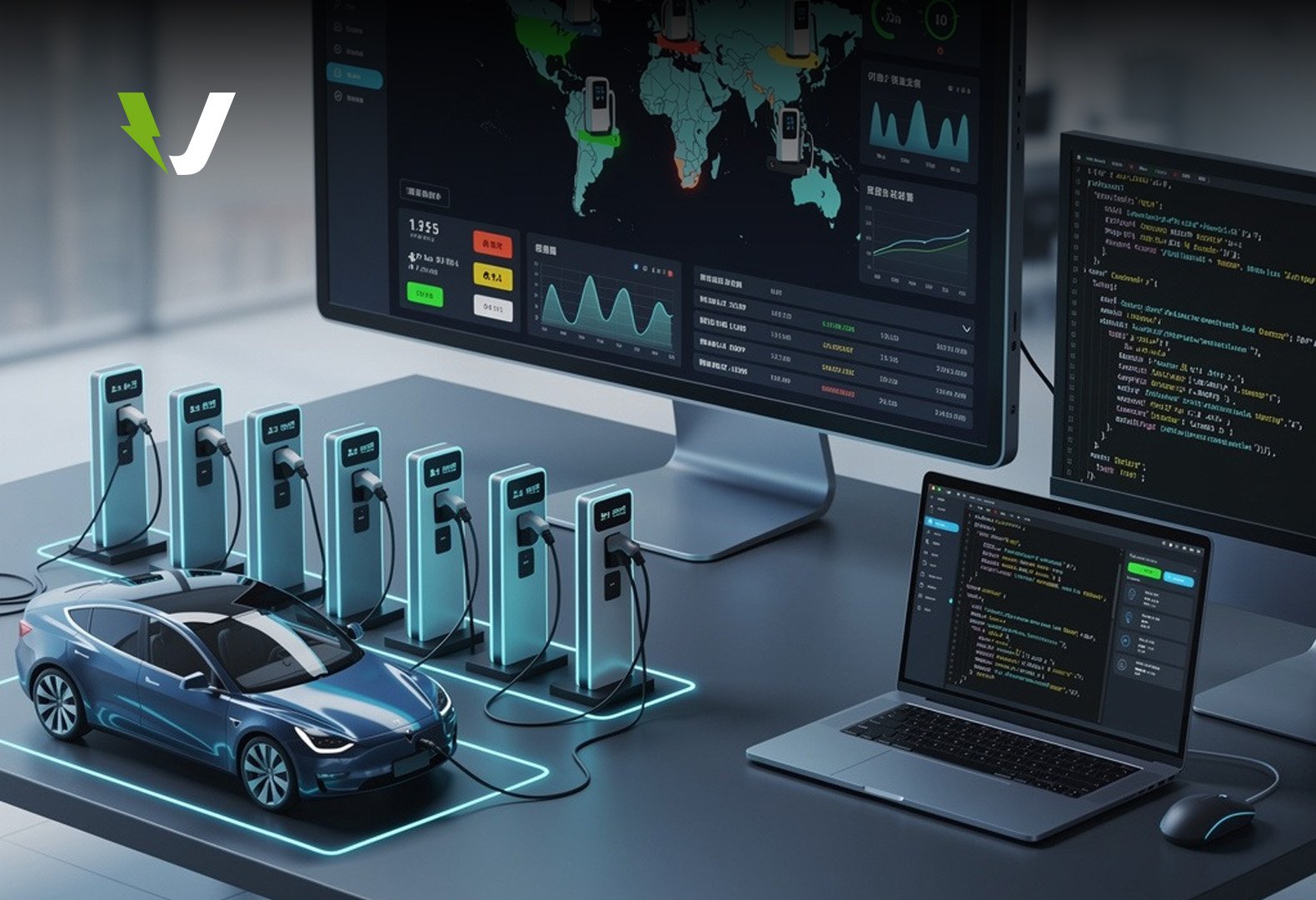
OCPP software is the backend and charging-station software that uses the Open Charge Point Protocol to let EV chargers communicate with a charging station management system, often called a CSMS.
The protocol is maintained by the Open Charge Alliance (OCA). As of 2026, OCPP 1.6, OCPP 2.0.1 and OCPP 2.1 are supported, with OCPP 2.1 being the newest generation and adding features such as bidirectional charging, improved smart charging and ISO 15118-20 support.
Table of Contents
- What Is OCPP Software?
- How OCPP Software Works
- OCPP 1.6 vs 2.0.1 vs 2.1
- Smart Charging and Plug & Charge
- Security, Device Management and Certification
- Choosing an OCPP Charging Platform
- FAQs
- Conclusion
Quick Information
| Detail | Information |
|---|---|
| Full name | Open Charge Point Protocol |
| Organization | Open Charge Alliance |
| Main purpose | Charger-to-backend communication |
| Common backend term | CSMS |
| Widely used version | OCPP 1.6 |
| Modern version | OCPP 2.0.1 |
| Latest version | OCPP 2.1 |
| OCPP 2.1 release | January 2025 |
| Key OCPP 2.1 features | V2X, ISO 15118-20, DER control |
| OCPP 2.0.1 IEC status | IEC 63584 |
| OCPP 2.1 IEC status | IEC 63584-210:2025 |
| Certification available | OCPP 1.6 and 2.0.1 |
What Is OCPP Software?
OCPP software allows an EV charging station and its management platform to exchange standardized messages instead of using a completely proprietary communication system.
For example, the charger can tell the backend when a vehicle starts charging, how much energy has been delivered, whether a connector has a fault and whether the station is available.
The backend can then send commands back to the charger, such as:
- Start or stop a charging session
- Change charging limits
- Authorize a driver
- Update charger configuration
- Schedule charging
- Retrieve diagnostic information
- Push firmware updates
This separation between hardware and software is important because it can reduce dependence on a single charging-equipment vendor.
Internal linking opportunity: Link this section to articles about EV charging management software, charging station backend systems or smart EV charging.
How OCPP Software Works
A typical OCPP setup contains two main components: the charging station and the Charging Station Management System, or CSMS.
The charger uses an OCPP implementation to communicate with the backend through a network connection. In many deployments, this communication uses JSON messages over WebSocket.
Simple charging example
Imagine a driver connecting an EV to a public charger.
The process may work like this:
- The charger connects to the CSMS.
- The driver identifies themselves.
- The charger asks the backend whether charging is authorized.
- Charging begins.
- Energy and transaction data are reported.
- The backend can adjust charging power if required.
- Charging ends.
- The session information is stored for billing and reporting.
This architecture allows a charging-network operator to supervise hundreds or thousands of chargers from one software platform.
OCPP 1.6 vs OCPP 2.0.1 vs OCPP 2.1
OCPP has evolved significantly.
The Open Charge Alliance says OCPP 1.6 was released in 2015 and introduced important functions including smart charging and JSON communication over WebSocket. It remains widely deployed.
OCPP 2.0.1
OCPP 2.0.1 was introduced in 2020 and added major improvements including:
- Better device management
- Improved transaction handling
- Stronger security
- More advanced smart charging
- ISO 15118 support
- Display and messaging functions
OCPP 2.0.1 is not backward compatible with OCPP 1.6, so a charger cannot automatically switch between them unless the vendor has implemented both versions.
OCPP 2.1
OCPP 2.1 was released in January 2025 and builds on OCPP 2.0.1.
Major additions include:
- ISO 15118-20 support
- Bidirectional charging
- Vehicle-to-grid and V2X functions
- Distributed energy resource control
- Improved smart charging
- Battery swapping
- Local cost calculation
- New payment and authorization methods
OCPP 2.1 remains compatible with OCPP 2.0.1 application logic, unlike OCPP 1.6.
In December 2025, OCPP 2.1 Edition 1 was also published as IEC 63584-210:2025, giving the protocol greater international standards recognition.
Smart Charging and Plug & Charge
One of the most useful functions of modern OCPP software is smart charging.
Instead of allowing every connected EV to draw maximum power at the same time, the CSMS can distribute available power according to site limits, electricity prices or charging priorities.
Practical example
Consider a depot with 20 electric delivery vans and only 400 kW of available charging capacity.
Without smart charging, the chargers could overload the site’s electrical limit. An OCPP-enabled platform can divide the available power between vehicles and give priority to vans that need to leave first.
This can help:
- Reduce peak demand
- Avoid expensive grid upgrades
- Charge fleets overnight
- Use lower electricity tariffs
- Coordinate solar and battery storage
OCPP 2.0.1 also supports ISO 15118 Plug & Charge, allowing compatible vehicles and chargers to authenticate using digital certificates rather than requiring a separate RFID card or app.
OCPP 2.1 extends this with ISO 15118-20 and bidirectional energy functions.
Security, Device Management and Certification
Security becomes more important as charging stations become connected infrastructure.
OCPP 2.0.1 includes improved security features and supports secure firmware updates, authentication and stronger device management. The updated OCPP 2.0.1 certification program requires core functions including secure firmware updating and Security Profile 2.
Device management
Modern CSMS platforms can monitor:
- Charger status
- Connector availability
- Firmware versions
- Configuration values
- Fault codes
- Communication health
- Charging transactions
- Energy consumption
OCPP 2.0.1 introduced a more flexible device model so operators can monitor and configure charger components in greater detail than with OCPP 1.6.
OCPP certification
The Open Charge Alliance operates an independent certification program.
Certification helps confirm that a charger or CSMS has been tested against the OCPP specification instead of simply claiming compatibility. OCA says certification can reduce integration risk and improve confidence in multi-vendor deployments.
As of 2026, formal certification programs cover OCPP 1.6 and OCPP 2.0.1. OCPP 2.1 test cases have been published, while certification tooling continues to develop.
Choosing an OCPP Charging Platform
A good OCPP software platform should support more than basic charger connectivity.
Operators should evaluate:
- Supported OCPP versions
- Charger compatibility
- OCPP certification
- Smart charging
- Remote diagnostics
- Firmware management
- Pricing and tariff tools
- RFID and app authentication
- Plug & Charge
- Payment integration
- Fleet charging
- Reporting and analytics
- API access
- Cybersecurity
- Roaming support
- Uptime monitoring
Open platform vs proprietary platform
| OCPP-based platform | Proprietary platform |
| Multi-vendor potential | Often tied to one vendor |
| Easier hardware switching | Migration may be difficult |
| Standard protocol | Custom communication |
| Certification possible | Vendor-specific testing |
| Larger integration ecosystem | Can offer deeper vendor-specific features |
OCPP does not guarantee that every charger will work perfectly with every backend. Optional profiles, firmware quality and vendor-specific implementations can still create compatibility issues.
That is why certification and real integration testing remain important.
FAQs
1. What is OCPP software?
OCPP software is charger and backend software that uses the Open Charge Point Protocol to exchange charging, authorization, monitoring and control information.
2. What is the latest OCPP version?
OCPP 2.1 is the latest version. It was released in January 2025 and adds features including bidirectional charging, ISO 15118-20 support and distributed energy resource control.
3. Is OCPP 1.6 still used?
Yes. OCPP 1.6 remains widely deployed and is still supported by the Open Charge Alliance, although newer projects increasingly consider OCPP 2.0.1 or 2.1.
4. Does OCPP support Plug & Charge?
Yes. OCPP 2.0.1 includes support for ISO 15118 Plug & Charge, while OCPP 2.1 adds support for ISO 15118-20.
5. Is OCPP software secure?
OCPP can support strong security, especially in newer versions, but security also depends on correct implementation, certificates, network configuration, firmware practices and backend architecture.
Conclusion
OCPP software is one of the key technologies behind scalable EV charging networks because it provides a common communication layer between charging hardware and management software.
Operators can review the latest specifications through the Open Charge Alliance, verify tested implementations through the OCA Certification Program, and download current protocol editions from the Open Charge Alliance OCPP library.
For companies choosing OCPP software in 2026, OCPP 1.6 still matters for installed infrastructure, OCPP 2.0.1 offers stronger device management and security, and OCPP 2.1 provides the clearest path toward bidirectional charging, smarter energy management and future grid integration.
Read more:
