



Dernière mise à jour: August 22, 2026
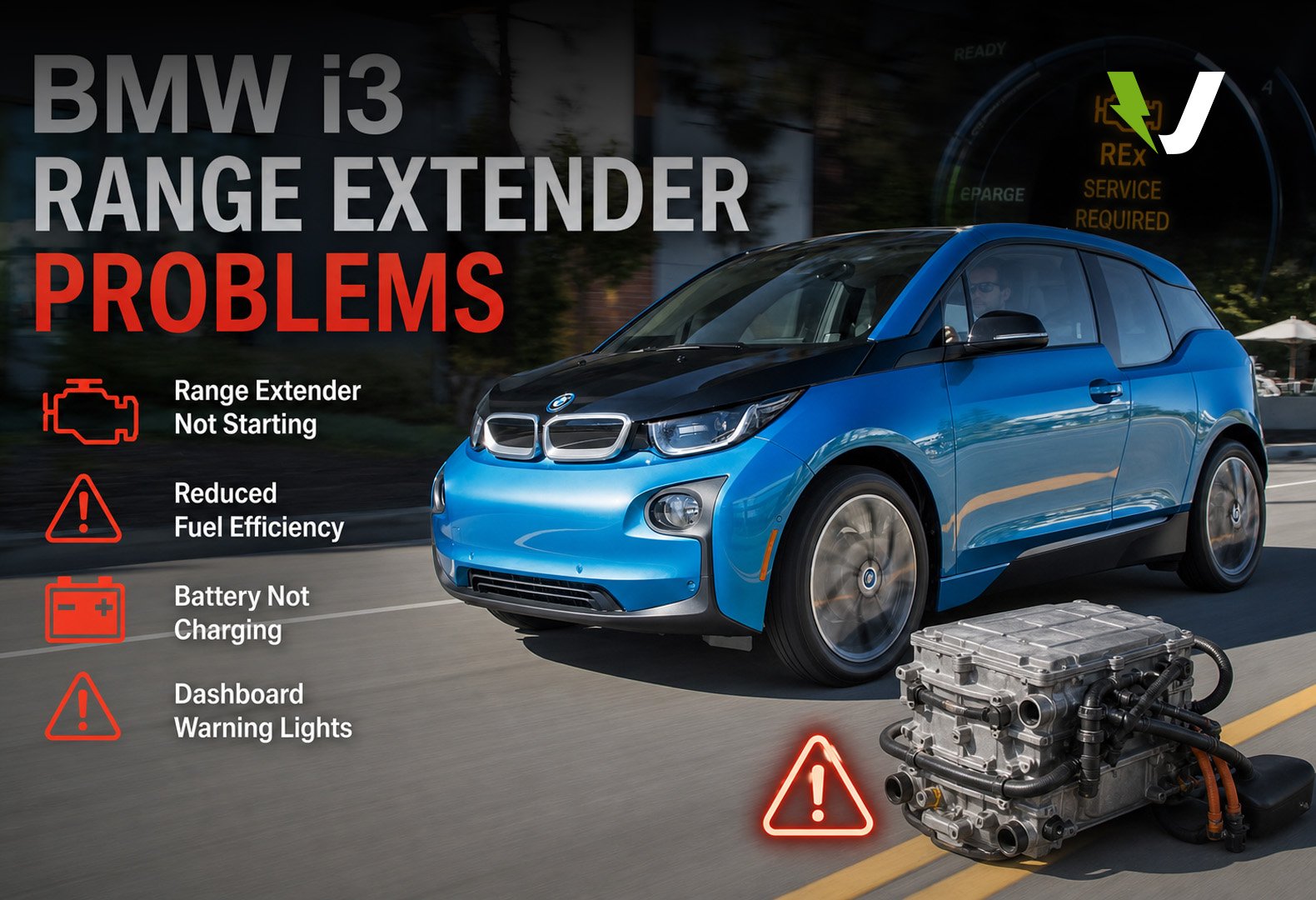
The BMW i3 range extender problems most often discussed involve the gasoline REx system rather than the main electric drivetrain. Documented issues include fuel-vapor system faults, coolant expansion-tank leaks, injector and oxygen-sensor problems, engine-mount hardware, and occasional drivetrain warnings.
The i3 REx remains unusual because its small gasoline engine does not directly drive the wheels. Instead, it acts mainly as a generator to maintain battery charge when the high-voltage battery becomes depleted. That extra hardware improves flexibility but also creates additional maintenance and repair points compared with the battery-only i3.
Table of Contents
- How the BMW i3 Range Extender Works
- Fuel Vent and Purge Valve Problems
- Coolant and Drivetrain Warning Issues
- Injectors, Misfires and Engine Problems
- Motor Mount and Electrical Faults
- What Used i3 REx Buyers Should Check
- FAQs
- Conclusion
Quick Information
| Issue | Possible symptom | Documented BMW action |
|---|---|---|
| Fuel tank vent line | Fuel vapor leak/fire risk | Safety recall |
| EVAP purge valve | Rough idle, hard starting, warning light | Extended warranty on eligible cars |
| Coolant expansion tank | “Only electric drive possible” warning | BMW service bulletin |
| Injectors/O2 sensor | Check-engine light, mixture faults | Component replacement bulletin |
| High-altitude misfire | Rough REx operation | BMW diagnostic procedure |
| Motor mount bolts | Mount damage after sudden traction loss | Service action |
| REx eMachine moisture | Drivetrain malfunction | Inspection/repair procedure |
How the BMW i3 Range Extender Works
The BMW i3 REx uses a 647 cc two-cylinder gasoline engine mounted at the rear of the vehicle. BMW’s technical data describes it as an internal-combustion engine that serves as a current maintainer for the high-voltage battery rather than a conventional propulsion engine.
That design means an i3 REx effectively contains two energy systems: a full electric drivetrain and a small gasoline generator system. The advantage is additional driving flexibility, but owners must also maintain engine oil, coolant, fuel-system components, and related emissions equipment. BMW’s maintenance literature specifically notes these extra service requirements.
Internal linking opportunity: Link this section to articles about BMW i3 battery degradation, range extender EVs, or used electric-car buying guides.
Fuel Vent and Purge Valve Problems
One of the most important documented BMW i3 range extender problems involved the fuel-tank vent line. BMW recalled certain 2014–2017 i3 REx vehicles because the vent line could rub against the positive battery cable.
According to the official recall, continued contact could wear through the line and allow fuel vapor into the engine compartment, increasing fire risk. BMW’s repair involved inspecting or replacing the line and adding a clip to prevent contact.
EVAP purge valve failure
A separate emissions-system issue involves the EVAP purge valve. BMW issued an extended limited-warranty program in 2024 for qualifying i3 REx vehicles because the valve can develop material or operational faults over time.
Possible symptoms include:
- Hard starting
- Rough engine operation
- Rough idle
- Metallic noise from the valve
- Check-engine light
- Fuel-mixture or tank-vent fault codes
Certain qualifying 2016–2017 vehicles in California and states following applicable emissions rules received coverage up to 15 years or 150,000 miles for this component. Coverage depends on VIN and registration location.
Coolant and Drivetrain Warning Issues
BMW documented another REx-specific issue involving the range-extender coolant expansion tank.
A leaking or damaged expansion tank could trigger the message:
“Drivetrain: only electric drive possible.”
When this happens, the electric portion of the car may continue operating, but the gasoline range extender can become unavailable. BMW’s 2016 technical bulletin instructed technicians to inspect the expansion tank, hoses, and mounting and replace damaged parts when necessary.
This is an important distinction for buyers. A drivetrain warning on an i3 does not automatically mean that the traction motor or high-voltage battery has failed; sometimes the fault is isolated to the REx system.
Injectors, Misfires and Engine Problems
Because the REx is still a gasoline engine, it can experience conventional combustion-related problems.
BMW documented cases where i3 REx vehicles displayed a malfunction indicator light along with fuel-air mixture errors. A 2016 service bulletin identified possible defects involving the oxygen sensor before the catalytic converter and the fuel injectors. BMW’s correction was replacement of the affected components after proper diagnosis.
High-altitude misfires
BMW also issued guidance for REx misfires occurring in a very specific situation: winter-blend fuel at elevations of 3,500 feet or higher.
The bulletin described misfire fault codes that could appear when the range extender operated at high altitude during winter conditions. BMW’s procedure included draining the fuel, using an approved additive, refilling with the specified fuel, and running a service test.
This was a condition-specific issue, so it should not be interpreted as evidence that every i3 REx suffers from misfires.
Motor Mount and Electrical Faults
BMW also carried out a service action involving motor-mount screws on certain i3 and i3 REx vehicles produced from October 1, 2013 to November 6, 2015.
The company found that sudden loss of traction during hard acceleration could damage the mounts. The REx version required attention to both left- and right-side drive-mount screws.
Moisture-related isolation faults
Another technical bulletin covered drivetrain-malfunction messages caused by electrical isolation faults. BMW identified two possible contributors: the high-voltage cable and, specifically on REx cars, excess moisture inside the REx eMachine after prolonged operation followed by rapid cooling.
Symptoms could include a temporary “Drivetrain Malfunction” message that disappeared after the vehicle was switched off and restarted.
Because these systems operate at high voltage, diagnosis and repairs should be performed by technicians trained to work on BMW electric vehicles.
What Used i3 REx Buyers Should Check
A used BMW i3 REx can still be appealing because it offers electric commuting without completely depending on public charging. However, the extra gasoline system makes service history especially important.
Before buying one, consider checking:
- VIN recall status for outstanding safety campaigns.
- Whether the fuel-tank vent-line recall was completed.
- Whether the car has stored drivetrain or check-engine faults.
- Range-extender coolant level and evidence of leaks.
- Service records for oil and coolant maintenance.
- Whether earlier motor-mount service actions were completed.
- Whether the REx starts and runs smoothly during a proper test.
A practical test is to have a BMW-capable technician activate the range extender and scan the vehicle’s control modules. A car that spends most of its life driving electrically may not reveal an REx fault during a short normal test drive.
Advantages of the REx system
- Extra driving range when battery charge becomes low
- Reduced dependence on charging infrastructure
- Useful backup for longer journeys
- Electric propulsion remains the primary drive system
Disadvantages
- More maintenance than the BEV version
- Additional emissions and fuel-system components
- More potential warning lights and fault codes
- Extra weight and mechanical complexity
- Aging gasoline components can require repairs
FAQs
1. Is the BMW i3 range extender reliable?
Many cars operate normally for years, but the REx adds mechanical and emissions equipment that the battery-only i3 does not have. Service history and recall completion are therefore important.
2. What is the most serious BMW i3 REx problem?
The fuel-tank vent-line issue was serious enough to trigger a safety recall because a damaged line could release fuel vapor and increase fire risk.
3. Why does my i3 say “only electric drive possible”?
BMW documented this warning in connection with a leaking range-extender coolant expansion tank, although other faults can produce similar messages. Proper diagnosis is required.
4. Does the BMW i3 REx need engine maintenance?
Yes. BMW specifies additional maintenance for the gasoline engine, including engine oil and cooling-system service.
5. How can I check BMW i3 recalls?
BMW allows owners to enter the vehicle’s VIN on its official recall page. The National Highway Traffic Safety Administration also provides VIN-based recall searches.
Conclusion
The main BMW i3 range extender problems are well enough documented to make a careful pre-purchase inspection worthwhile. Fuel-vent issues, purge-valve faults, coolant leaks, injectors, oxygen sensors, early motor-mount hardware, and occasional REx electrical faults are among the areas buyers should understand.
Owners can check open campaigns through BMW USA, review official safety information through the National Highway Traffic Safety Administration, and use BMW’s published maintenance guidance to understand REx-specific service needs.
The presence of these documented BMW i3 range extender problems does not automatically make every REx a poor purchase. A properly maintained example with completed recalls, clean diagnostics, and a smoothly functioning generator can still offer a useful combination of electric driving and gasoline-backed range.
Read More:
