

Dernière mise à jour: August 23, 2026
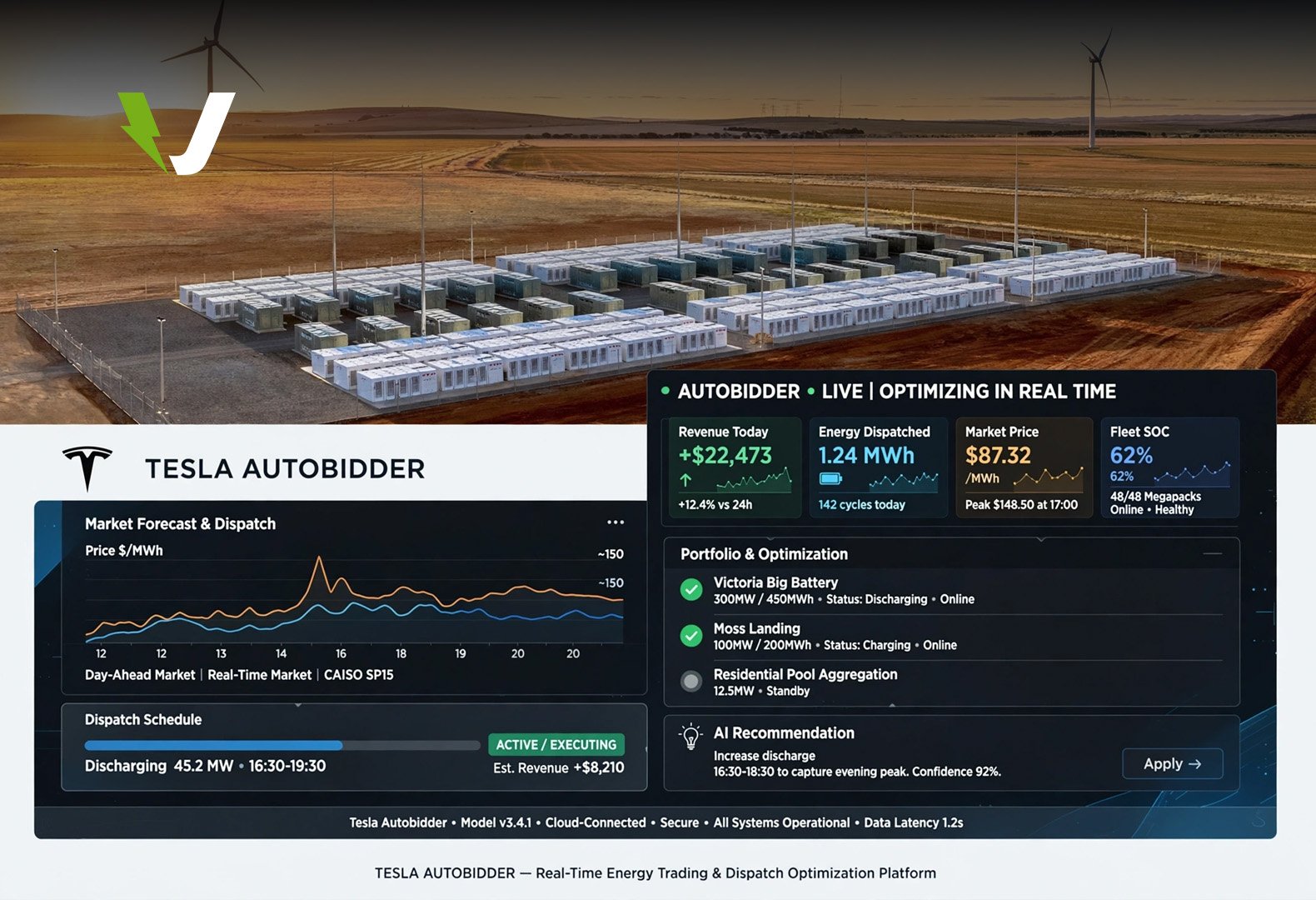
Tesla Autobidder is a real-time energy trading and battery-control platform designed to help utilities, independent power producers, and energy investors earn value from battery storage systems. It automatically decides when stored electricity should be charged, discharged, or offered into electricity markets.
Tesla says Autobidder combines forecasting, machine learning, numerical optimization, and automated bidding. It is especially important for Tesla Megapack projects, where software can turn a large battery from simple energy storage into an actively managed grid asset.
Table of Contents
- What Is Tesla Autobidder?
- How Tesla Autobidder Works
- AI, Forecasting and Smart Bidding
- Autobidder and Tesla Megapack
- Hornsdale Power Reserve Case Study
- Benefits, Risks and Limitations
- FAQs
- Conclusion
Quick Information
| Detail | Tesla Autobidder |
|---|---|
| Product type | Energy trading and control software |
| Developer | Tesla |
| Main users | Utilities, power producers, investors |
| Main application | Battery energy storage |
| Key Tesla hardware | Megapack |
| Main functions | Forecasting, dispatch, bidding, optimization |
| Markets supported | Day-ahead, real-time and continuous markets where applicable |
| AI use | Machine learning and optimization algorithms |
| Cloud based | Yes |
| Human oversight | Yes |
| Major deployment | Hornsdale Power Reserve, Australia |
What Is Tesla Autobidder?
Tesla Autobidder is part of Tesla’s Autonomous Control software suite. Its purpose is to manage batteries according to electricity prices, grid conditions, contractual obligations, battery limits, and the owner’s financial objectives.
Large batteries can make money in several ways rather than simply buying electricity when it is cheap and selling it when prices rise. Autobidder can coordinate several of these revenue opportunities at the same time.
Tesla lists uses including:
- Wholesale electricity trading
- Ancillary grid services
- Capacity markets
- Renewable-energy firming
- Transmission and distribution services
- Bilateral energy contracts
- Portfolio optimization
Internal linking opportunity: Link this section to articles about Tesla Megapack, battery energy storage systems, or AI in electricity trading.
How Tesla Autobidder Works
Autobidder receives information about the battery, electricity market, expected demand, renewable generation, and operating constraints. It then calculates what the battery should do to create the highest expected value while respecting settings chosen by the operator.
For example, a Megapack may charge when electricity is inexpensive because solar generation is high. Several hours later, Autobidder may discharge that stored electricity when demand and wholesale prices increase.
A simplified process
The platform can generally be understood in five steps:
- Collect market and battery data.
- Forecast prices, electricity demand, and generation.
- Calculate the most valuable battery strategy.
- Submit or adjust electricity-market bids.
- Dispatch the battery and repeat the process as conditions change.
Tesla says Autobidder continuously executes transactions using numerical optimization models. Human operators establish and modify the parameters, including business objectives and risk preferences.
This means Autobidder is automated, but it is not simply an uncontrolled AI trader.
AI, Forecasting and Smart Bidding
Tesla describes Autobidder as using a combination of machine learning, classical statistics, and numerical optimization.
Its algorithm library includes:
- Electricity-price forecasting
- Load forecasting
- Generation forecasting
- Dispatch optimization
- Smart bidding
Forecasting matters because electricity markets can change rapidly. A battery operator needs to estimate whether storing energy now will create more value than immediately selling it.
Tesla also says its algorithms improve using operating data and can be adapted to new markets and services.
Why optimization is important
Suppose a 100 MWh battery has several possible opportunities at the same time. It might earn revenue from energy trading, reserve services, or frequency regulation.
Using all available battery capacity for one service could prevent it from participating in a more valuable opportunity later. Autobidder therefore attempts to co-optimize multiple revenue streams rather than treating each decision separately.
Tesla Autobidder and Megapack
Autobidder is closely associated with Tesla Megapack, the company’s utility-scale battery storage product.
Tesla’s 2025 annual filing specifically identifies Autobidder as its optimization platform for Megapack batteries. Tesla says its energy-storage products can also receive firmware updates and use software platforms to improve their operation over time.
Tesla currently reports more than 58 GWh of Megapack storage operating globally, with installations across more than 65 countries.
Software and hardware integration
Tesla emphasizes vertical integration between:
- Battery cells
- Battery-management systems
- Power electronics
- Inverters
- Firmware
- Cloud software
- Market interfaces
Autobidder is hosted on Tesla’s cloud infrastructure and can communicate with electricity-market operators, network providers, and customer networks through secure web APIs.
One benefit is that the software understands operating limits and battery warranties. Tesla says Autobidder considers the cost and benefit of potential battery actions while accounting for warranties and maintenance requirements.
Hornsdale Power Reserve Case Study
One of the best-known applications of Tesla Autobidder is the Hornsdale Power Reserve in South Australia.
Following South Australia’s major September 2016 blackout, Neoen and Tesla were selected to build the Hornsdale battery. The original system entered operation in 2017 with 100 MW of power and 129 MWh of storage.
The facility was later expanded by another 50 MW and 64.5 MWh, creating a combined system of approximately 150 MW / 194 MWh.
Tesla states that Autobidder has operated at Hornsdale and participated in electricity-market bidding.
Beyond energy trading
Hornsdale also demonstrates that batteries can provide more than price arbitrage.
The Australian Renewable Energy Agency reports that the expanded system provides frequency-control services and uses Tesla’s Virtual Machine Mode to support grid stability and synthetic inertia.
Autobidder should not be confused with every technical control function at Hornsdale, but the project shows how battery hardware, grid controls, and market software can work together.
Benefits, Risks and Limitations
Tesla Autobidder can make large batteries more useful by reacting much faster than traditional manual trading processes.
Advantages
- Automated 24/7 market participation
- Real-time battery dispatch
- Multiple revenue streams
- AI-assisted price and demand forecasting
- Integration with Tesla Megapack
- Battery warranty considerations
- Fast response to changing electricity markets
- Reduced workload for trading teams
Limitations
- Revenue depends on electricity-market conditions
- Forecasts can be wrong
- Market rules vary by country and region
- Batteries still suffer physical degradation
- Cloud connectivity and cybersecurity are important
- Software cannot create profitable market conditions where none exist
- Human operators still need suitable risk settings and oversight
Autobidder therefore does not guarantee profits. Tesla describes it as a platform that helps owners optimize their assets according to their own objectives and risk preferences.
FAQs
1. What does Tesla Autobidder do?
Tesla Autobidder automatically manages and trades electricity from battery-storage assets using forecasting, optimization, and market-bidding software.
2. Does Tesla Autobidder use AI?
Yes. Tesla says the platform uses machine learning alongside classical statistics and numerical optimization for forecasting, dispatch, and bidding.
3. Is Autobidder used with Tesla Megapack?
Yes. Tesla’s current corporate reporting identifies Autobidder as an optimization platform for Megapack battery systems.
4. Does Autobidder replace human energy traders?
Not completely. Tesla says human operators set and adjust parameters reflecting the trading desk’s objectives and risk preferences, while Autobidder executes transactions automatically.
5. Where is Tesla Autobidder being used?
Tesla identifies Hornsdale Power Reserve in South Australia as a major Autobidder deployment. Its software also manages battery assets at multiple scales globally.
Conclusion
Tesla Autobidder shows how battery storage is becoming as much a software business as a hardware business. Instead of leaving Megapack batteries waiting for simple charge-and-discharge commands, the platform can forecast market conditions, optimize competing opportunities, and automatically submit energy-market bids.
Readers can explore the platform through Tesla Autobidder, learn about its utility-scale hardware through Tesla Megapack, and review a major real-world battery project through the Australian Renewable Energy Agency.
For utilities and battery owners, the value of Tesla Autobidder ultimately depends on market rules, battery characteristics, electricity-price volatility, and the quality of its forecasts. Its importance lies in demonstrating how AI, cloud software, energy storage, and automated trading can operate as one integrated grid technology.
Read more:
