


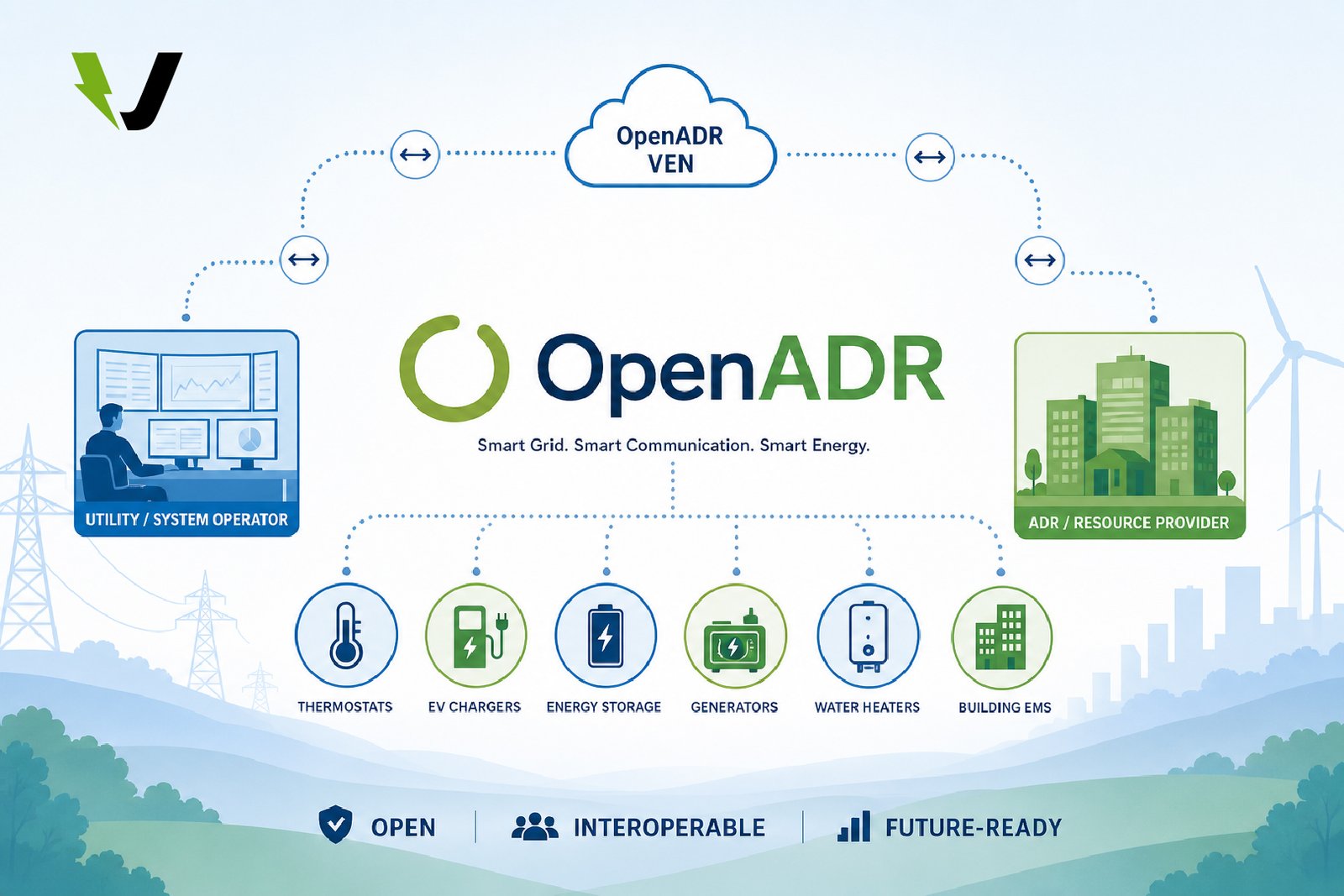
OpenADR stands for Open Automated Demand Response. It is an open communication standard that helps utilities, grid operators, aggregators, buildings, batteries, and EV charging platforms exchange demand-response and energy-management signals automatically.
For electric mobility, OpenADR can help charging systems respond to grid conditions, electricity prices, renewable-energy availability, and utility demand-response events. The latest OpenADR 3 standard uses a simpler REST-based architecture designed for modern distributed energy resources, including EV chargers and battery storage.
Table of Contents
- What Is OpenADR?
- How OpenADR Works
- OpenADR 2.0b vs OpenADR 3
- OpenADR for EV Charging
- VTN, VEN and Smart Energy Control
- Security, Certification and Integration
- FAQs
- Conclusion
Quick Information
| Detail | Information |
|---|---|
| Full name | Open Automated Demand Response |
| Main purpose | Automated grid and demand-response communication |
| Maintained by | OpenADR Alliance |
| Important versions | OpenADR 2.0b and OpenADR 3 |
| OpenADR 3 launch | November 2023 |
| OpenADR 3 architecture | REST API and JSON |
| OpenADR 2.0b architecture | XML and web-service based |
| Main roles | VTN and VEN |
| EV use | Managed and flexible charging |
| DER support | EVs, batteries, solar and other energy resources |
| International standard | OpenADR 2.0b recognized as IEC 62746-10-1 |
| Certification | Available for OpenADR 2.0 and OpenADR 3 |
What Is OpenADR?
OpenADR is a standardized way for energy providers and connected devices to communicate about electricity demand.
A utility might need customers to reduce electricity use during a period of unusually high grid demand. Instead of manually calling businesses and asking them to reduce consumption, an OpenADR system can send an automated event to participating buildings, batteries, charging stations, or energy-management platforms.
The OpenADR Alliance describes the standard as supporting automated demand response, distributed energy-resource management, dynamic electricity pricing, and grid reliability.
Typical connected resources can include:
- EV charging stations
- Commercial buildings
- HVAC systems
- Battery storage
- Solar installations
- Industrial equipment
- Home energy systems
- Fleet charging depots
Internal linking opportunity: Link this section to articles about smart EV charging, vehicle-to-grid technology, or demand response explained.
How OpenADR Works
OpenADR normally connects an organization that sends energy signals with devices or platforms that receive and respond to those signals.
For example, a utility could announce that electricity demand will be particularly high between 5:00 p.m. and 7:00 p.m. An EV charging-management platform receiving that message might temporarily reduce charging power for vehicles that do not need to leave until the following morning.
A simplified process looks like this:
- A utility or grid operator creates a demand-response event.
- The OpenADR server distributes the event.
- Participating energy systems receive it.
- Local software evaluates the requested action.
- Loads such as EV chargers may reduce or shift consumption.
- The system can report its response or energy data back.
The goal is not necessarily to switch devices off. OpenADR can communicate prices, schedules, requested load changes, and other information that allows the receiving system to decide how to respond.
OpenADR 2.0b vs OpenADR 3
OpenADR 2.0b remains an important and widely deployed version of the standard.
It supports advanced demand-response events, pricing, reporting, registration, and telemetry. In 2018, it was adopted as the international standard IEC 62746-10-1.
OpenADR 2.0b
OpenADR 2.0b primarily uses:
- XML
- Structured web services
- More complex messaging
- VTN and VEN architecture
- Reporting and telemetry
- Demand-response event scheduling
It remains relevant for utilities and existing demand-response deployments.
OpenADR 3
The OpenADR Alliance launched OpenADR 3 in November 2023.
OpenADR 3 does not replace 2.0b. Instead, the Alliance describes it as an additional, simpler implementation option for newer applications.
It uses:
- REST APIs
- JSON
- OpenAPI specifications
- Simpler web-development methods
- Modern software integration patterns
| Feature | OpenADR 2.0b | OpenADR 3 |
| Main data format | XML | JSON |
| Interface style | Web services | REST API |
| Complexity | Higher | Simplified |
| Existing deployments | Extensive | Growing |
| EV/DER support | Yes | Strong modern focus |
| Certification | Yes | Yes |
The OpenADR Alliance’s 2025 annual report notes that OpenADR 3 is intended to make energy-management integration simpler while supporting newer distributed-energy applications.
OpenADR for EV Charging
EV charging is one of the clearest modern uses for OpenADR because large groups of chargers can create substantial electricity demand.
A fleet depot with 100 electric vans, for example, could potentially draw several megawatts if every vehicle begins charging at maximum power simultaneously.
OpenADR allows the utility side of the system to communicate grid conditions to the charging-management platform.
Practical EV charging example
Suppose a depot has 20 chargers and vehicles normally charge between 6:00 p.m. and 6:00 a.m.
At 6:30 p.m., the utility sends a demand-response event requesting lower electricity use until 8:00 p.m.
The charging platform could:
- Reduce total charging power.
- Delay vehicles leaving late the next morning.
- Continue charging urgent vehicles.
- Restore normal charging after the event.
- Report energy data back to the utility.
The OpenADR Alliance has documented a real EV charging integration involving SWITCH and AMPECO. In that case, OpenADR 3 events were used to trigger power limits, while the charging platform distributed available capacity between charge points using dynamic load management.
This demonstrates how utility communication and charger-management software can work together without the utility directly controlling each charger individually.
VTN, VEN and Smart Energy Control
Two important OpenADR terms are VTN and VEN.
Virtual Top Node
A VTN, or Virtual Top Node, is generally the system that creates or distributes OpenADR information.
Examples could include:
- A utility platform
- Grid operator
- Demand-response provider
- Energy aggregator
Virtual End Node
A VEN, or Virtual End Node, receives and responds to those messages.
A VEN could be:
- EV charging platform
- Building energy-management system
- Battery controller
- Industrial energy system
The OpenADR Alliance tests interoperability between VTN and VEN products through its certification program.
Where OpenADR fits with OCPP
OpenADR and OCPP are not competitors.
A common architecture could look like:
Utility → OpenADR → Charging platform → OCPP → EV chargers
OpenADR communicates energy or demand-response requirements between the grid and charging-management platform.
OCPP handles communication between the charging-management platform and individual chargers.
Similarly, OCPI can handle roaming and commercial information between charging networks, while ISO 15118 handles communication between an EV and charger.
Security, Certification and Integration
Because OpenADR can influence real electricity consumption, security and interoperability are important.
The OpenADR Alliance operates certification programs for both OpenADR 2.0 and OpenADR 3 products. The Alliance specifically tests communication between VTNs and VENs.
OpenADR 3 also offers a modern testing framework based on its RESTful architecture. Developers can use official test assets and an Alliance testing tool before certification.
Advantages of OpenADR
- Open industry standard
- Automated demand response
- Dynamic electricity pricing support
- EV charging integration
- Battery and DER support
- Utility-to-customer interoperability
- International standardization
- Can reduce manual energy-management work
Limitations
- Integration still requires software development.
- Existing utilities may use different OpenADR versions.
- Demand-response programs vary by market.
- Participation rules may differ between utilities.
- OpenADR does not directly replace OCPP charger management.
- Reliable connectivity and cybersecurity remain important.
Companies evaluating the standard should therefore confirm which OpenADR profile their utility, aggregator, or software partner requires.
FAQs
1. What does OpenADR stand for?
OpenADR stands for Open Automated Demand Response. It enables automated communication of energy prices, grid events, and demand-response information.
2. What is the latest OpenADR version?
OpenADR 3 is the newest generation. It was launched in November 2023 and provides a simplified REST API and JSON-based approach.
3. Is OpenADR 2.0b still used?
Yes. OpenADR 2.0b remains widely relevant and is recognized internationally as IEC 62746-10-1. OpenADR 3 was not designed simply to replace it.
4. How does OpenADR help EV charging?
OpenADR can send grid, pricing, or demand-response signals to an EV charging platform, which can then delay or reduce charging according to grid conditions.
5. What is the difference between OpenADR and OCPP?
OpenADR mainly connects utilities or energy programs with flexible energy resources. OCPP connects EV chargers with their charging station management system.
Conclusion
OpenADR provides an important communication layer between the electricity grid and flexible energy resources such as EV chargers, batteries, buildings, and renewable-energy systems.
Companies can review the official standards through the OpenADR Alliance specification library, examine certification requirements through the OpenADR Alliance Certification Program, and learn about the international OpenADR 2.0b standard through the International Electrotechnical Commission.
For EV charging operators, OpenADR becomes especially valuable when combined with OCPP-based charger management. OpenADR can communicate what the grid needs, while the charging platform determines how individual chargers should respond.
Read more:
