


Last updated: August 30, 2026
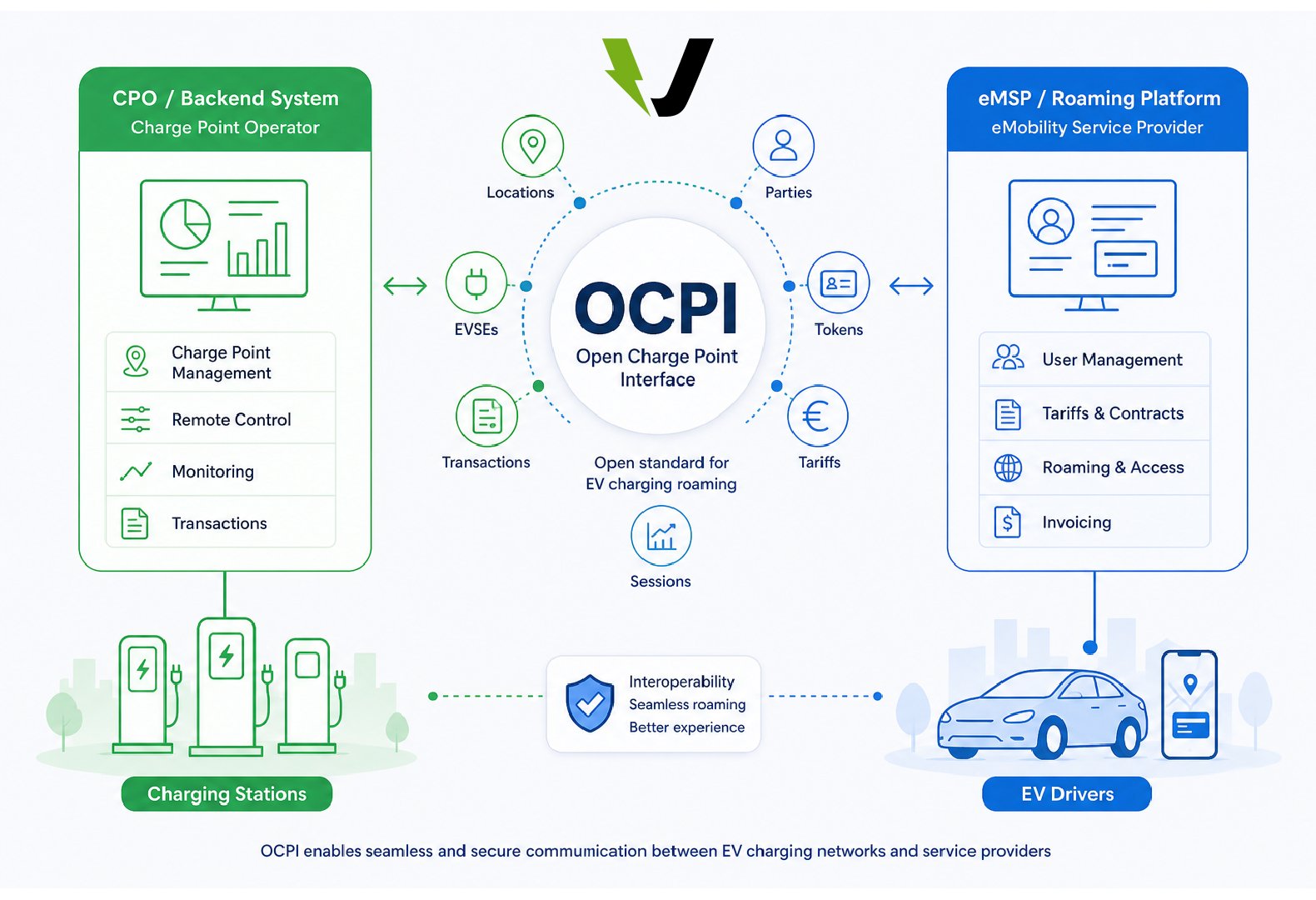
OCPI stands for Open Charge Point Interface. It is an open protocol that allows companies in the electric-vehicle charging ecosystem to exchange information about chargers, prices, charging sessions, authorization and billing.
Its main purpose is EV roaming. A driver who has an account with one mobility provider can potentially use charging stations operated by another company because their platforms exchange standardized data through OCPI. The protocol is developed and maintained by the EVRoaming Foundation.
Table of Contents
- What Is OCPI?
- How OCPI Works
- OCPI 2.3.0 and Other Versions
- Main OCPI Modules and Use Cases
- OCPI vs OCPP and ISO 15118
- FAQs
- Conclusion
Quick Information
| Detail | Information |
|---|---|
| Full name | Open Charge Point Interface |
| Short name | OCPI |
| Maintained by | EVRoaming Foundation |
| Main purpose | EV charging roaming and data exchange |
| Current version | OCPI 2.3.0 |
| Older widely used version | OCPI 2.2.1 |
| Future version | OCPI 3.0, currently draft |
| Main participants | CPOs, eMSPs, roaming hubs |
| Main data | Locations, tariffs, sessions, CDRs, tokens |
| Smart charging | Supported |
| Direct payment | Supported in OCPI 2.3.0 |
| Booking | Optional module |
| EU AFIR support | Added in OCPI 2.3.0 |
What Is OCPI?
OCPI is designed mainly to connect Charge Point Operators (CPOs) with eMobility Service Providers (eMSPs).
A CPO operates the physical charging infrastructure. An eMSP usually provides the customer-facing app, charging card, subscription or account that drivers use to access charging services.
The EVRoaming Foundation says OCPI can work through direct peer-to-peer connections or through roaming hubs. This allows different companies to exchange information without requiring every EV driver to maintain a separate account with every charging network.
Internal linking opportunity: Link this section to articles about EV roaming, charging station management software or CPO vs eMSP.
How OCPI Works
Imagine a driver has an account with Mobility Provider A but stops at a charger owned by Charging Operator B.
OCPI can exchange the information required to make that session work.
A simplified process looks like this:
- The CPO shares charger locations and availability.
- The eMSP shows those chargers in its app.
- The driver chooses a charger.
- Authentication information is exchanged.
- Charging begins.
- Session data is updated.
- The final Charge Detail Record is sent.
- The eMSP can use that information for customer billing.
OCPI can also support remote commands such as starting and stopping charging through an app.
Why roaming matters
Without roaming, EV drivers could need many different applications, cards and accounts.
OCPI helps create a more connected ecosystem where:
- Charger locations can appear across different apps.
- Availability can update in near real time.
- Tariffs can be displayed before charging.
- Drivers can use networks outside their normal provider.
- Charging records can move between businesses.
That makes OCPI particularly important as public charging networks expand across borders.
OCPI 2.3.0 and Other Versions
The current official version is OCPI 2.3.0. It became available in February 2025 and builds on the widely implemented OCPI 2.2.1 specification.
OCPI 2.3.0 was developed partly to address newer regulatory and payment requirements.
OCPI 2.2.1
Version 2.2.1 introduced or improved several important functions, including:
- Smart charging
- CDR data
- Real-time charging-session information
- Multiple roles
- Roaming hubs
- Signed meter values
- Remote commands
It remains important because many existing platforms still use it.
OCPI 2.3.0
Major additions include:
- EU AFIR National Access Point data
- More flexible tax structures
- Plug & Charge indication
- Direct Payment support
- Accessibility-related information
- Vehicle-type information
- Protocol extensions
- Optional booking functionality
The EVRoaming Foundation says 2.3.0 was designed partly for regulatory compliance and easier extensibility.
What about OCPI 3.0?
OCPI 3.0 is not yet the production release.
As of August 2026, the EVRoaming Foundation describes OCPI 3.0 as a draft and targets approximately mid-2027 for release. It is also intended to become an official CENELEC standard.
Main OCPI Modules and Use Cases
OCPI is divided into modules. Companies implement the modules needed for their role in the ecosystem.
Core CPO-to-eMSP implementations generally include:
- Versions — discovers supported OCPI versions.
- Credentials — establishes the connection between platforms.
- Locations — shares charging-station and EVSE data.
- Sessions — provides active charging-session information.
- CDRs — sends completed Charge Detail Records.
- Tariffs — communicates charging prices.
- Tokens — supports driver authentication.
The EVRoaming Foundation considers these modules central to a proper CPO/eMSP OCPI implementation.
Optional and advanced modules
Additional modules can provide:
- Remote start and stop
- Charging profiles
- Smart charging
- Roaming hub information
- Direct payments
- Charger booking
The Booking module for OCPI 2.3.0 can support reservations at location or individual charging-point level, different calendars and even no-show fees.
Practical fleet example
Consider a company operating electric delivery vans across several countries.
Its fleet platform could use one eMSP account while drivers access chargers from multiple CPOs. Through OCPI, the fleet manager could receive charging locations, session information, tariffs and CDRs in a standardized format.
This can simplify expense tracking and reduce the need to manually reconcile dozens of charging-network accounts.
OCPI vs OCPP and ISO 15118
OCPI is often confused with OCPP, but they solve different problems.
| Protocol | Main Connection | Primary Purpose |
| OCPI | CPO ↔ eMSP/hub | Roaming and business data |
| OCPP | Charger ↔ CSMS | Charger control and management |
| ISO 15118 | Vehicle ↔ charger | EV-to-charger communication |
OCPI vs OCPP
OCPP connects the physical charging station with its backend management system.
OCPI usually operates at a higher business level, connecting different charging companies and mobility providers.
For example:
EV → charger → OCPP → CPO backend → OCPI → eMSP
This simple chain shows how the protocols can complement rather than replace each other.
OCPI and Plug & Charge
ISO 15118 handles communication between the EV and charger and can support Plug & Charge authentication.
OCPI 2.3.0 includes information that can indicate Plug & Charge capabilities, helping roaming platforms exchange relevant service data.
Advantages of OCPI
- Open and free protocol
- Supports bilateral roaming
- Supports roaming hubs
- Real-time charger information
- Standardized tariffs
- Standardized billing records
- Smart charging support
- Cross-border potential
- Reduced vendor lock-in
Limitations
- Different implementations can still behave differently.
- Legacy versions may require migration.
- Businesses still need commercial roaming agreements.
- Security depends on correct implementation.
- Data quality depends on participating operators.
- OCPI does not directly control charger hardware.
The EVRoaming Foundation testing tools can help companies test OCPI 2.2.1 and 2.3.0 implementations.
FAQs
1. What does OCPI stand for?
OCPI stands for Open Charge Point Interface. It is an open protocol for exchanging EV charging information between CPOs, eMSPs and roaming platforms.
2. What is the latest OCPI version?
The current official version is OCPI 2.3.0. OCPI 3.0 remains in draft as of August 2026.
3. What is the difference between OCPI and OCPP?
OCPP connects chargers to charging-management systems. OCPI mainly connects charging operators, mobility providers and roaming platforms.
4. Does OCPI support smart charging?
Yes. OCPI supports charging profiles that can be used for smart-charging applications. The ChargingProfiles module is optional but recommended for smart-charging use cases.
5. Is OCPI free to use?
Yes. The EVRoaming Foundation describes OCPI as an independent protocol that is freely available for the EV charging ecosystem.
Conclusion
OCPI is one of the key protocols behind EV charging interoperability. It allows charging operators, mobility providers and roaming hubs to exchange location information, prices, authentication data, sessions and billing records in a standardized way.
Readers can review the current protocol through the EVRoaming Foundation OCPI resources, download specifications through the official OCPI downloads library and explore implementation testing through the EVRoaming Foundation tools.
For companies building charging infrastructure or automotive SaaS products, OCPI matters because it sits between networks rather than inside one charger. OCPP manages chargers, ISO 15118 connects vehicles with chargers, and OCPI helps turn many separate charging businesses into a more usable roaming ecosystem.
Read more:
