



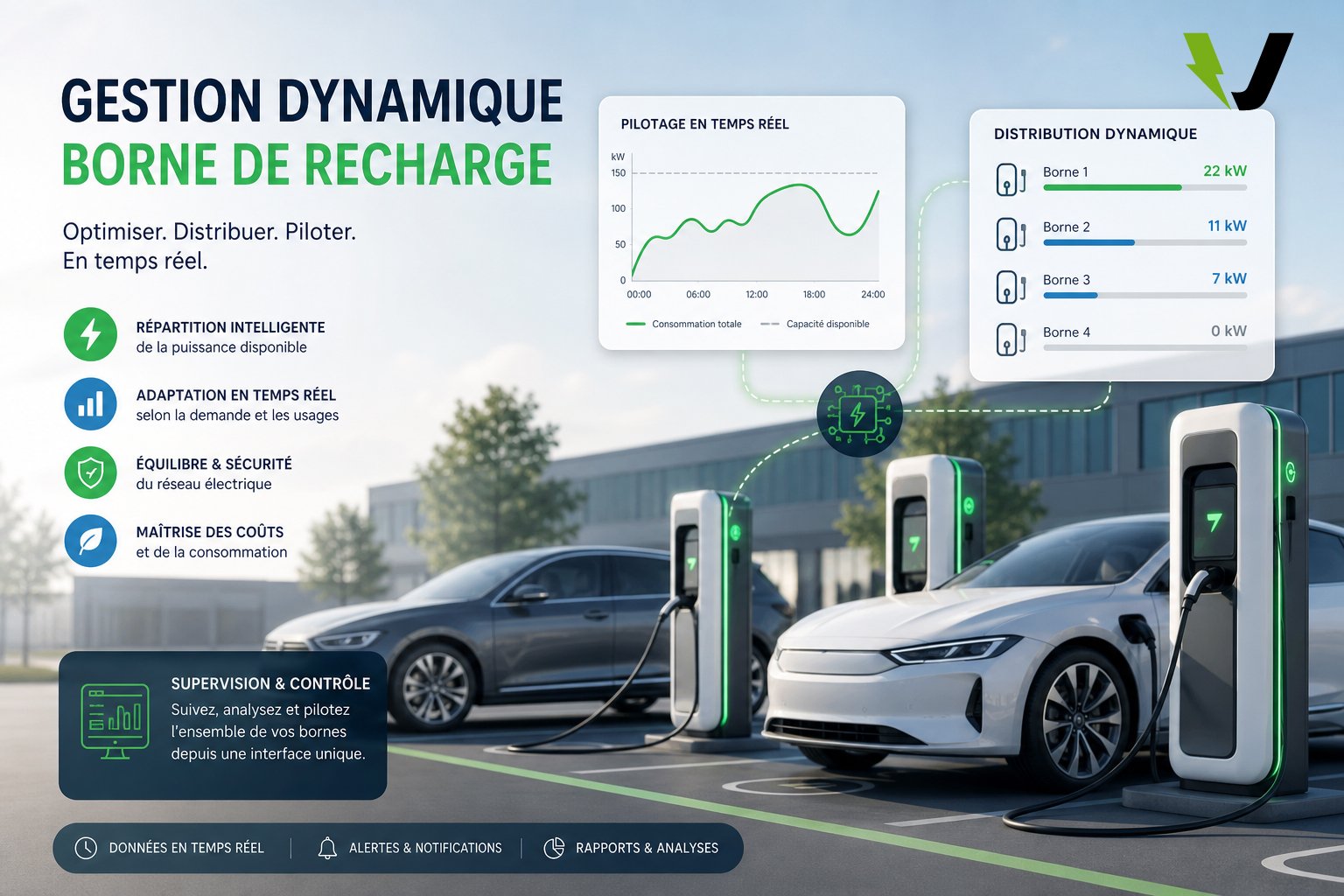
Gestion dynamique borne de recharge is the French term commonly used for dynamic management of EV charging stations. In English, it is usually called dynamic load management, dynamic charging management, or intelligent load balancing.
The system continuously measures how much electrical power is available at a building or charging site and adjusts EV charging power in real time. This can help businesses install more chargers without automatically increasing their electrical connection capacity. Schneider Electric describes dynamic management as allocating the building’s remaining available power to EV charging according to real-time demand.
Table of Contents
- What Is Gestion Dynamique Borne de Recharge?
- How Dynamic EV Charging Works
- Static vs Dynamic Load Management
- Benefits for Fleets and Commercial Buildings
- Software, OCPP and Smart Charging
- Costs, Limitations and EU Requirements
- FAQs
- Conclusion
Quick Information
| Detail | Explanation |
|---|---|
| French term | Gestion dynamique borne de recharge |
| English term | Dynamic EV load management |
| Main purpose | Control charging power in real time |
| Input data | Building demand, grid limit, charger demand |
| Main benefit | Avoid electrical overload |
| Typical users | Fleets, offices, apartments, public charging |
| Works with multiple chargers | Yes |
| Can prioritize vehicles | Yes, depending on software |
| Can reduce infrastructure upgrades | Often |
| Can use electricity tariffs | Yes |
| Relevant protocol | Often OCPP |
| EU smart charging relevance | Covered by AFIR and related EU rules |
What Is Gestion Dynamique Borne de Recharge?
Gestion dynamique borne de recharge means that EV charging power changes automatically according to the electrical capacity available at a site.
Imagine an office building with a 200 kW electrical limit. The building may use only 90 kW early in the morning but 170 kW during a busy afternoon. A dynamic system can give EV chargers much more power when the building is using less electricity and reduce charging when other electrical loads increase.
The aim is to keep total demand below a defined limit.
A simplified rule is:
Available EV charging power = site power limit − current building demand
This allows charging infrastructure to share electrical capacity with heating, cooling, machinery, lighting and other building loads.
Internal linking opportunity: Link this section to articles about OCPP software, smart EV charging, or fleet charging infrastructure.
How Dynamic EV Charging Works
A typical system uses an energy meter or electrical monitoring equipment to measure site consumption continuously.
A controller or charging-management platform then determines how much power can safely be allocated to connected EVs. Siemens describes dynamic load management as automatically responding to power limits while protecting electrical equipment from overload.
Step-by-step example
Consider a depot with four 22 kW AC charging stations.
If all four chargers operated at full power, their theoretical combined requirement would be:
4 × 22 kW = 88 kW
Suppose the site can safely allocate only 60 kW to EV charging at that moment.
The management system could distribute that power approximately as:
- Vehicle 1: 15 kW
- Vehicle 2: 15 kW
- Vehicle 3: 15 kW
- Vehicle 4: 15 kW
Later, if one vehicle finishes charging, more capacity can be redirected to the remaining vehicles.
More advanced systems can prioritize particular cars according to departure time, required battery level or driver importance.
Static vs Dynamic Load Management
Static and dynamic charging management solve similar problems but work differently.
Static load management
Static management sets a fixed maximum capacity for the EV chargers.
For example, if a site reserves 60 kW for charging, the chargers must always stay within that 60 kW limit regardless of how much electricity the rest of the building is using.
Dynamic load management
Dynamic management monitors other building loads and adjusts the available EV charging capacity continuously.
| Static Management | Dynamic Management |
|---|---|
| Fixed EV power limit | EV limit changes in real time |
| Simpler system | Requires monitoring |
| May leave power unused | Uses spare capacity efficiently |
| Lower complexity | More optimization options |
| Limited flexibility | Better for larger installations |
Schneider Electric notes that dynamic systems can allocate remaining building energy to charging in real time, while static systems operate below a predetermined fixed limit.
Benefits for Fleets and Commercial Buildings
Dynamic charging becomes especially useful when many EVs must share one electrical connection.
Typical installations include:
- Fleet depots
- Apartment buildings
- Shopping centers
- Hotels
- Offices
- Factories
- Parking garages
- Public charging hubs
One major advantage is avoiding unnecessary grid upgrades. Siemens states that dynamic load management can reduce or sometimes avoid electrical reinforcement by using existing capacity more efficiently.
Practical fleet example
Consider a company with 30 electric delivery vans.
Not every van needs maximum charging power immediately. Some vehicles may leave at 6:00 a.m., while others are not required until 10:00 a.m.
Charging-management software could prioritize the earliest departures first.
It may also reduce charging during expensive electricity periods and increase power overnight when both building demand and tariffs are lower.
Main advantages
- Reduces risk of electrical overload
- Makes better use of existing grid capacity
- Supports more chargers at one site
- Can reduce peak-demand costs
- Allows vehicle prioritization
- Supports fleet departure schedules
- Can integrate renewable energy
- Reduces unnecessary infrastructure spending
Software, OCPP and Smart Charging
Modern dynamic management increasingly depends on software.
A Charging Station Management System can monitor chargers, vehicle sessions and power limits while communicating with individual charging points through protocols such as OCPP.
A typical architecture might look like:
Electric meter → energy controller → charging platform → OCPP → chargers
The system may also receive information from:
- Building Management Systems
- Solar panels
- Battery storage
- Utility signals
- Energy-price feeds
- Fleet-management platforms
Schneider Electric’s current charging-management products, for example, support dynamic load management and integration with both building-management and charging-station-management systems.
Intelligent charging priorities
Software can distribute energy using different rules.
Possible strategies include:
- Equal sharing
- First-in, first-out
- Priority vehicles
- Departure-time priority
- Minimum guaranteed charging power
- Lowest electricity cost
- Battery state-of-charge priority
Siemens lists strategies including split allocation, priority-based splitting and FIFO-type approaches in its dynamic charging-management system.
Costs, Limitations and EU Requirements
The price of a dynamic charging solution depends heavily on installation size.
A small office may require only a meter, compatible chargers and basic load-balancing software. A large depot may need transformers, industrial controllers, cloud software, network equipment and integration with fleet-management systems.
Possible costs
Businesses may need to budget for:
- Smart electricity meters
- Charging controllers
- OCPP-compatible chargers
- Software licenses
- Installation
- Network connectivity
- Energy-management integration
- Maintenance
Dynamic management does not create additional electrical capacity. It only uses existing capacity more intelligently.
If a depot requires 1 MW continuously but the grid connection can provide only 300 kW, software alone cannot solve that fundamental capacity problem.
EU smart charging requirements
European regulation increasingly recognizes smart charging.
The European Commission explains that AFIR requires publicly accessible charging points to support smart-recharging functionality. Its guidance defines smart charging around the ability to adjust electricity delivered to the vehicle battery in real time.
Related EU rules also address smart charging for certain new or replaced non-public charging points.
This does not mean every installation must use an identical dynamic load-management system. Technical implementation can differ depending on the site and regulatory requirement.
FAQs
1. What does gestion dynamique borne de recharge mean?
It means dynamically adjusting EV charger power according to the electrical capacity currently available at a building or charging site.
2. Does dynamic charging make an EV charge faster?
It can when spare capacity is available. However, the main goal is optimization rather than guaranteeing maximum charging speed at all times.
3. Can dynamic load management prevent electrical overload?
Yes. Properly designed systems can keep combined charging demand within the site’s defined electrical limits and reduce overload risk.
4. Does dynamic charging require OCPP?
Not always. Proprietary systems exist, but OCPP can make charger-to-management-platform integration more flexible and reduce dependence on one hardware vendor.
5. Is dynamic charging useful for fleets?
Yes. Fleets can prioritize vehicles by departure time, manage many chargers within a limited connection and potentially shift charging toward cheaper electricity periods.
Conclusion
Gestion dynamique borne de recharge is becoming an important part of scalable EV infrastructure because simply adding more chargers without controlling their combined demand can create expensive electrical problems.
Schneider Electric explains how dynamic energy management distributes available building power to charging infrastructure in real time, while Siemens provides commercial dynamic load-management systems designed to protect electrical infrastructure and optimize charging capacity. European smart-charging requirements can also be followed through the European Commission.
For businesses planning gestion dynamique borne de recharge, the best solution depends on site capacity, number of EVs, departure schedules, charger power, energy tariffs and future expansion. Good dynamic management should make charging infrastructure more scalable without sacrificing electrical safety or vehicle availability.
Read more:
