



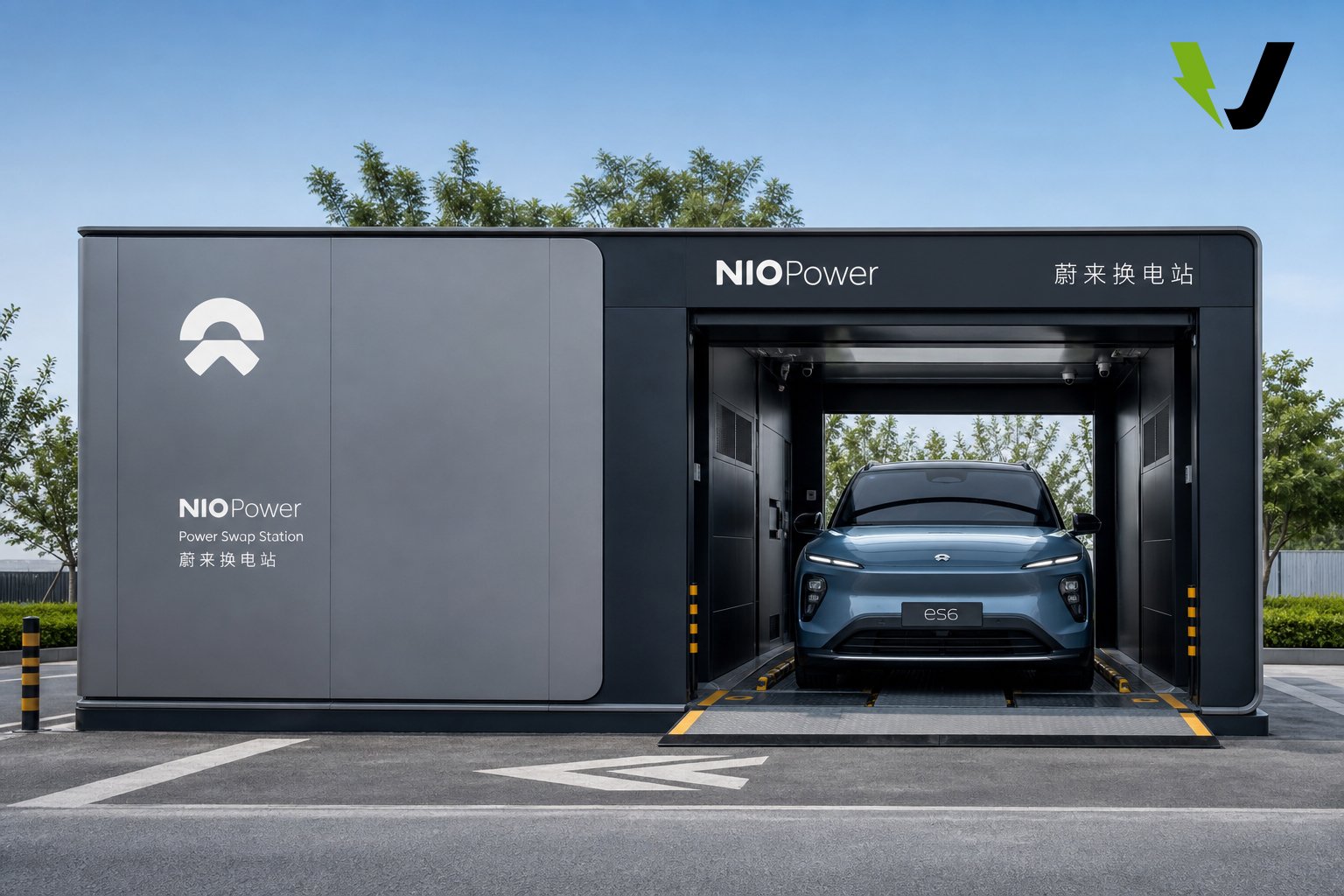
NIO Power Swap Stations are automated facilities that remove a depleted EV battery and replace it with a charged pack in only a few minutes. Instead of waiting for conventional DC fast charging, compatible NIO and ONVO vehicles can drive into a swap station and leave with a replenished battery.
As of February 6, 2026, NIO reported 3,790 Power Swap Stations worldwide and more than 100 million completed battery swaps. The company also said its average swap now takes about three minutes and that fifth-generation stations are scheduled to begin deployment during 2026.
Table of Contents
- What Are NIO Power Swap Stations?
- How a NIO Battery Swap Works
- Power Swap Station 4.0 Technology
- NIO Battery as a Service
- Network Size in China and Europe
- Battery Swapping vs Fast Charging
- FAQs
- Conclusion
Quick Information
| Detail | Current Information |
|---|---|
| System | NIO Power Swap |
| Main purpose | Automated EV battery replacement |
| Average swap time | About 3 minutes |
| Power Swap Station 4.0 | 144-second swap |
| Gen 4 battery capacity | Up to 23 stored batteries |
| Gen 4 daily capacity | Up to 480 swaps |
| Worldwide stations | 3,790 as of Feb. 6, 2026 |
| Total swaps completed | More than 100 million |
| China highway stations | 1,020 |
| Planned new stations in 2026 | 1,000 |
| Europe network | Around 60 stations reported in early 2026 |
| Business model | Battery as a Service, or BaaS |
| Fifth generation | Planned to go live in 2026 |
What Are NIO Power Swap Stations?
NIO Power Swap Stations are automated service centers designed to replace a vehicle’s entire high-voltage battery pack instead of charging it while it remains inside the car.
NIO describes Power Swap as a fully automated process that can complete the battery replacement in roughly three minutes. The station also performs checks on the battery and electric-drive system during the process.
This gives NIO owners several possible ways to replenish energy:
- Battery swapping
- Home AC charging
- Public DC fast charging
- NIO Power charging stations
- Mobile charging services
The important difference is that swapping separates vehicle charging time from battery charging time. The station can charge stored batteries while drivers continue using other packs.
Internal linking opportunity: Link this section to articles about EV battery swapping, Battery as a Service, or ultra-fast EV charging.
How a NIO Battery Swap Works
The process is designed to require very little driver involvement.
A simplified swap works like this:
- The driver selects an available Power Swap Station.
- The vehicle enters the station.
- Automated positioning systems align the car.
- The station removes the existing battery.
- The battery is inspected and placed into storage.
- A charged compatible battery is installed.
- The vehicle performs a system check.
- The driver leaves.
The driver normally remains inside the vehicle throughout the process.
NIO says the complete experience, including parking and self-inspection, can take less than five minutes, while the actual battery-changing process is approximately three minutes.
This makes swapping competitive with gasoline refueling in terms of time, although availability still depends heavily on having a compatible swap station nearby.
Power Swap Station 4.0 Technology
NIO introduced Power Swap Station 4.0 in June 2024.
The fourth-generation station is significantly more advanced than earlier versions and was designed to support NIO vehicles, ONVO models, and potentially vehicles from battery-swap technology partners.
Main Power Swap Station 4.0 specifications
- 144-second battery swap
- 22% faster than Gen 3
- Storage for up to 23 batteries
- Up to 480 swaps per day
- Six ultrawide-field-of-view LiDAR sensors
- Four Nvidia Orin X processors
- 1,016 TOPS of computing capability
These sensors and processors help automate vehicle positioning, battery handling, and station operations.
NIO launched the station alongside a 640 kW liquid-cooled DC charger, showing that its strategy is not battery swapping instead of charging. The company is developing both systems together.
NIO Battery as a Service
Battery swapping works closely with NIO’s Battery as a Service, or BaaS, business model.
Under BaaS, the customer purchases the vehicle without permanently purchasing the battery. Instead, the battery is owned separately and the customer pays a subscription for the right to use compatible battery packs.
This model can provide several advantages.
Lower upfront vehicle price
Separating the battery from the vehicle purchase can reduce the initial vehicle cost.
Battery upgrades
Customers may be able to temporarily or permanently move to a larger-capacity battery when needed.
For example, a driver could use a standard-range pack for normal commuting and temporarily upgrade before a long-distance trip. NIO says its current system supports flexible battery upgrades with different usage periods.
Battery-health management
Because batteries repeatedly return to NIO’s swap network, the company can monitor their condition and perform maintenance.
NIO says BaaS customers gain access to maintained battery inventory rather than being tied permanently to one physical battery pack.
Network Size in China and Europe
Battery swapping becomes useful only when stations are available in enough locations.
NIO reported that it had deployed 3,790 Power Swap Stations worldwide by February 6, 2026, including 1,020 stations along major highways in China. The company plans to add another 1,000 stations during 2026.
The same announcement confirmed that NIO had passed 100 million cumulative battery swaps, delivering 5.28 billion kWh of energy through swapping.
Europe
Europe has a much smaller network.
NIO Norway reported in February 2026 that customers had access to around 60 battery swap stations across Europe, including 20 in Norway.
That is a meaningful network, but it remains far less dense than NIO’s infrastructure in China.
NIO also operates a Power Europe facility in Hungary that manufactures, services, and supports swap stations for European markets.
Battery Swapping vs Fast Charging
Battery swapping and DC fast charging solve the same problem in different ways.
| Battery Swapping | DC Fast Charging |
|---|---|
| Replaces battery | Recharges existing battery |
| About 3 minutes with NIO | Usually significantly longer |
| Requires special station | Much wider charger compatibility |
| Requires standardized battery design | Works across many EV architectures |
| Supports battery upgrades | Battery remains with vehicle |
| High infrastructure complexity | Easier network expansion |
| Strong with BaaS | No battery subscription required |
Main advantage
The biggest advantage of NIO Power Swap Stations is speed.
A swap can be faster than even today’s highest-power charging systems because the depleted battery is removed rather than charged while the driver waits.
Main limitation
The biggest limitation is infrastructure.
Swap stations are complex and expensive, and vehicle manufacturers must design cars around compatible battery packs and mounting systems.
That makes battery swapping harder to standardize across the entire automotive industry.
Energy storage potential
Swap stations may also become part of the power grid.
NIO’s European technology white paper says the company is developing bidirectional swap stations capable of interacting with the grid and is exploring peak-shifting and renewable-energy integration.
If developed at scale, stored batteries could provide more value than simply waiting for the next vehicle.
FAQs
1. How long does a NIO battery swap take?
NIO says its current Power Swap system averages about three minutes. Power Swap Station 4.0 can complete the physical swap in approximately 144 seconds.
2. How many NIO Power Swap Stations are there?
NIO reported 3,790 stations worldwide as of February 6, 2026. It plans to build another 1,000 during 2026.
3. How many batteries can a NIO swap station hold?
Power Swap Station 4.0 can store up to 23 battery packs and perform as many as 480 swaps per day under suitable operating conditions.
4. Do you need NIO BaaS to use battery swapping?
Access rules depend on market and ownership arrangement. BaaS is specifically designed around battery subscription and swap access, and NIO promotes it as the main way to use its flexible battery services.
5. Is NIO developing a new swap station generation?
Yes. NIO stated in February 2026 that its fifth-generation Power Swap Stations will go live during 2026, although detailed final specifications were not provided in that announcement.
Conclusion
NIO Power Swap Stations offer one of the clearest real-world examples of battery swapping operating at commercial scale. By February 2026, NIO had completed more than 100 million swaps across a network of 3,790 stations, showing that the concept has moved well beyond an experimental stage.
For official information about the technology, explore NIO Power, NIO’s Power Swap Station 4.0 announcement, and its Battery as a Service information. These sources explain how battery swapping, fast charging, battery subscriptions, and future energy services fit together.
The long-term question is whether other automakers will adopt compatible battery architectures. For now, NIO Power Swap Stations demonstrate that battery swapping can provide refueling-like speed when the vehicle design, battery ownership model, and infrastructure network are built around the same system.
Read more:
